
Review: Feed the Scorchpot
I've mentioned before that the people who I know that play board games and the people who I know that play video games are – surprisingly, to me – two very different groups of people. I fall into both categories (and, okay, so do one or two others) but it does feel like my 'board game buds' and my 'video game v… friends' are pretty disparate from one another.
But even if you're not into board games, one you've likely to have at least heard of is Catan… and if you're not into video games – weird that you're on this website – but one that might've eeked into your consciousness in the last couple of years is Balatro, so this self-proclaimed crossover between the two should tick at least one box for quite a lot of people.
Feed the Scorchpot from husband-and-wife team Moravian has been solidly on my radar since it popped up during the most recent Steam Next Fest, drawing me in with a familiar-looking board and, admittedly, some familiar-sounding mechanics: rolling dice to activate your island's hexagonal tiles which provide one of a range of different resources. However this island has no stone or wood to speak of: here it's all food-based, with your seven resources being fish, spices, fruit and vegetables, meat, milk and wheat. That's on account of your primary goal being to feed a dragon with an ever-increasing appetite: at first a meager 250 portions of food will be enough to sate them but each year the dragon returns expecting more and more. Successfully feed them for 20 years and you'll be victorious, fail and… well, it is a dragon.
-
Developer: Moravian
Publisher: Indieformer
Release: 20 August 2026
Retail Price (Steam): 14,99€/$14.99/£13.75
It's worth mentioning fairly early that, as Catan-like as it might look and sound, the game doesn't really feel anything like it, past the first few basic mechanics. The bones are certainly there: in addition to the dice rolling, both games have core buildings – 'settlements' in Catan and 'humble farmsteads' in Scorchpot – that harvest resources from any activated tiles which they're adjacent to; the placement of those buildings will also be familiar, at the junctions where three tiles meet, and, if you're well-versed in Catan and are particularly eagle-eyed, you might notice that even the distribution of the numbers on those tiles is effectively identical.
Past that, though, the two games begin to diverge from one another pretty rapidly: in Catan players are always looking to build on 6s and 8s, as those are the most likely numbers to come up, but that's rarely the strategy in the Scorchpot. The rewards being skewed in favour of the less-common pairings mean you're incentivised to work on a strategy that sees you trying to hit those instead, and you're aided in that goal by having several rerolls, and abilities that allow you to heavily manipulate your dice and the board itself.
Those aren't your only methods to ensure you provide a good enough offering to please your dragons, as they're not going to be satisfied by sheer amount: they also want some flavour to their meals. There are lots of ways to get that flavour: there are many different buildings available and some of them will help provide it, but the main method is by using the game's recipes, which are the final piece of a fairly complex puzzle. While the first few years can usually be managed without them, they become a key part of your late-game strategies, without which it would become almost impossible to appease your fiery friend. Each recipe has some sort of pre-requisite, needing you to collect a certain amount of a particular resource (and sometimes only triggering if certain other goals are achieved), but reward you with significant multipliers that, assuming you can pull them off, will be sure to help you avoid ending up in the scorchpot yourself.
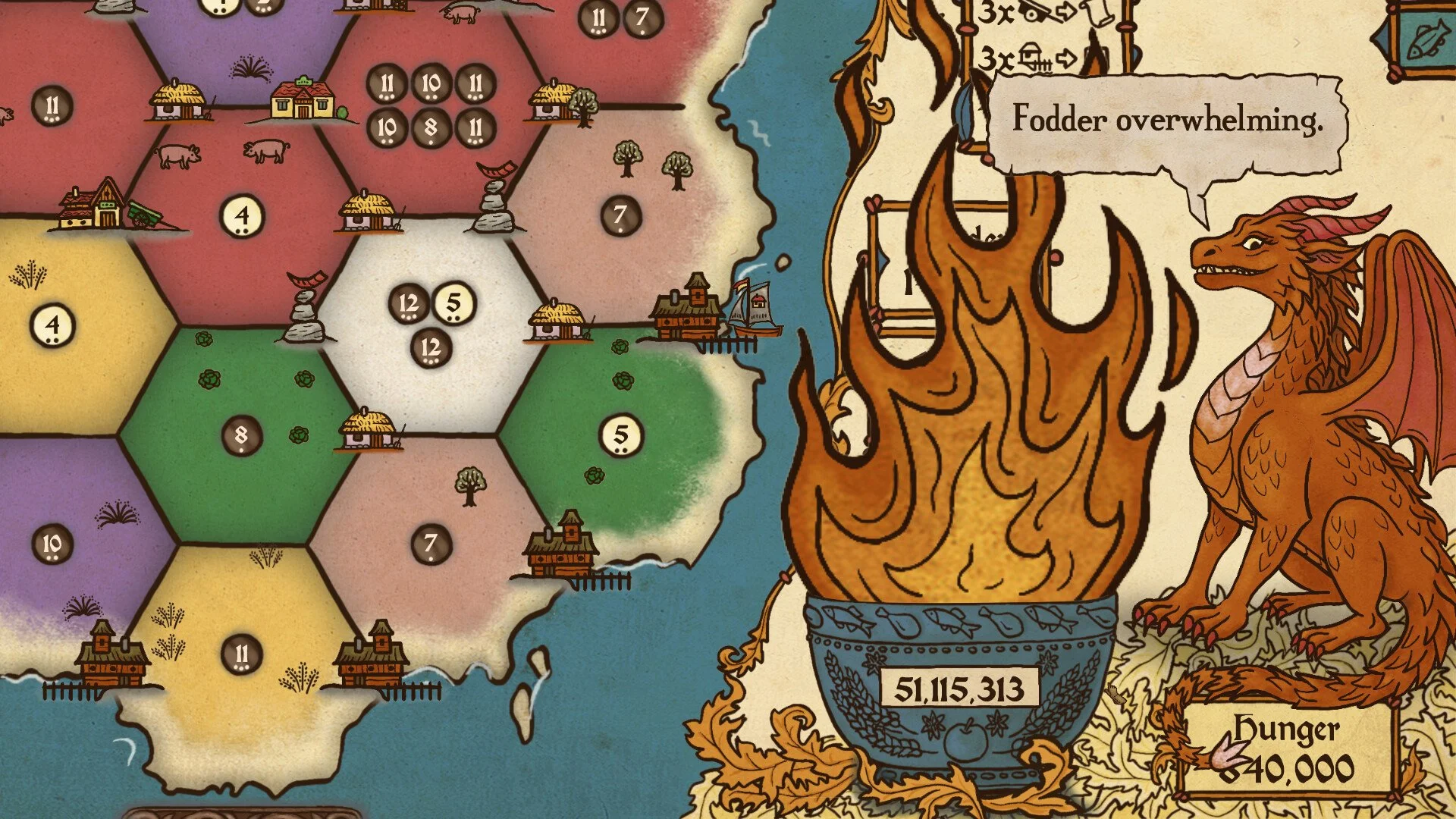
Image: Moravian / Indieformer
For Balatro fans, I suppose there's a similarity there with that game's jokers – with recipes even sitting in a little bay at the top of your screen. I'm actually far less qualified to make the Balatro comparison than the Catan one, as for the record (and the three of you that are keeping track), I've still managed to avoid playing it out of fear of becoming consumed: if the thirty hours or so that I've so far sunk into Feed the Scorchpot are anything to go by, that's probably a sensible decision.
That does mean my roguelite point of reference is a little skewed, but it certainly feels a lot more unique to me than many of the others that have come and gone in the past few years. There is a numbers-go-up-ness to it that should feel familiar to roguelite aficionados, along with those 'push your luck' and 'break the game' mechanics that the genre is known for, but there's also a lot more to balance and a lot more to think about: I think one of my main points of contention with most other roguelikes is the grindy, 'going-through-the-motions' nature of them, where I don't necessarily feel like I'm having fun – except for one or two moments where I took a run into endless mode (i.e. past year 20) without a particular goal in mind, I'm yet to encounter that feeling in Feed the Scorchpot.
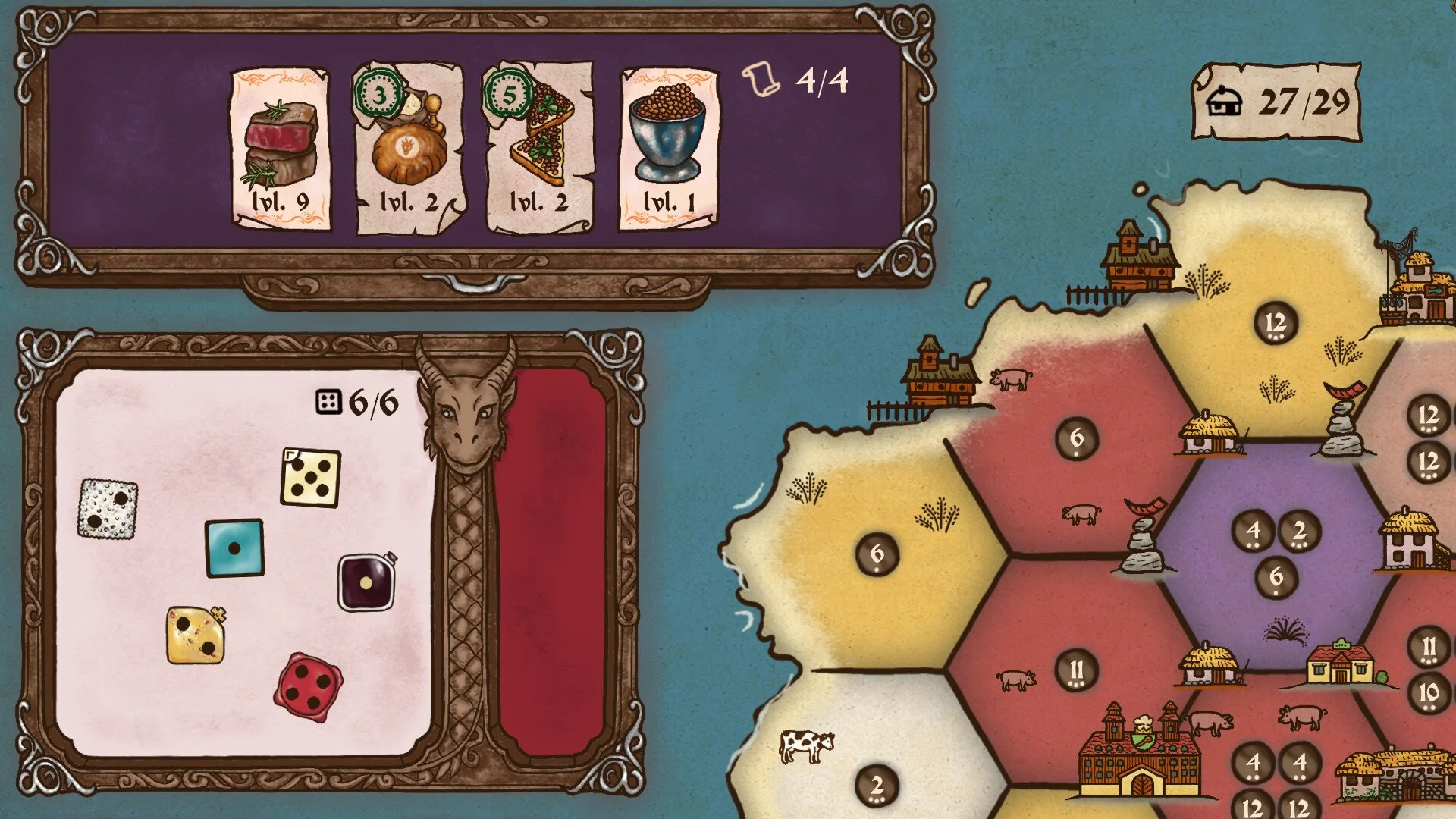
Image: Moravian / Indieformer
In general, there's just an awful lot to do here in the Scorchpot, but it's all introduced in a way that you never feel overwhelmed. It took me 8 hours to beat what you could argue is the game's tutorial – before you unlock deckbuilding, (because, yes, there is also a bit of deckbuilding involved), and that's after having spent a similar amount of time in the demo.
A small amount of that "content" does disagree with me: for example, there are eight dragons with their own unique mechanics and ten difficulty levels, which is great, but it means that if you want a catalogue full of little dragon icons you're looking at a minimum of 80 successful runs. At time of writing I've not yet completed the final, tenth, difficulty level with each of the dragons, so that's my current goal, but once I've done that I don't know that I'd have much desire to ever play on difficulties 2 through 9 again. You need to do that once, with any dragon, to unlock the next level so I have exactly one win on each of those difficulties, but I don't really see a good reason why defeating a dragon on, for example, level 10 shouldn't mark all the earlier difficulties too. Thankfully, there's no mechanical reason you'd need to do that, or even an achievement for doing so: but any completionist neuroses that you might have are likely to be a little put-out by seeing those mocking little unlocked padlock symbols next to your incomplete dragon-difficulty combinations.
Fortunately, most of the content isn't like that: a far more interesting area is the trophies – the game's achievements – which are, by design, difficult. Again, as a reminder, I've played over thirty hours and have completed six of the forty currently available, and chasing those, along with unlocking all the game's recipes, buildings, and dice is a much more palatable task to me, but one that will take, I imagine, a lot more work to do.
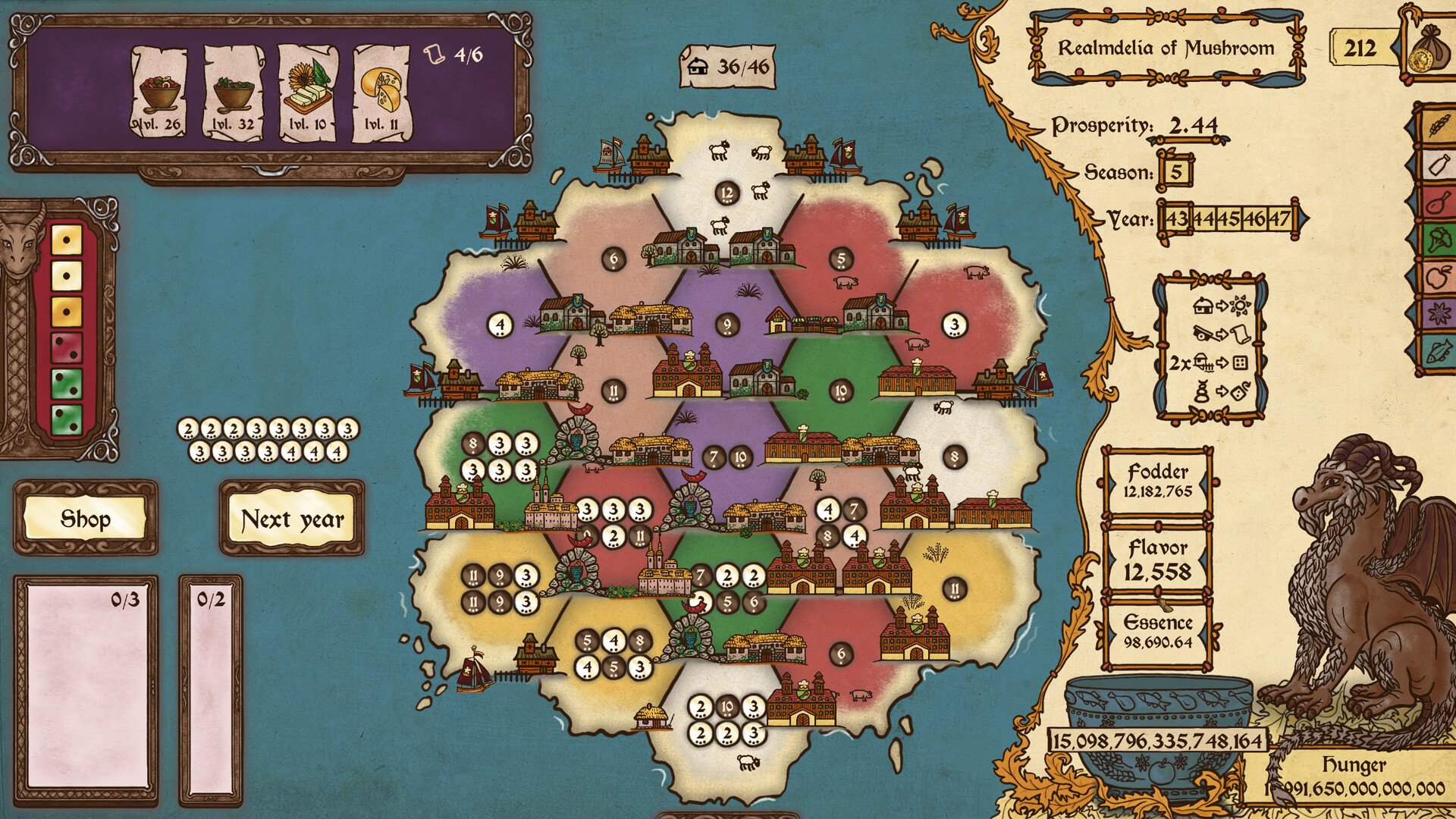
Image: Moravian / Indieformer
In part, that's because, in a way that I understand might be frustrating for some, but which I (mostly) appreciated, the game really doesn't hold your hand – I'm starting to feel a bit more competent at it but, honestly, there's still a bunch of trophies which I look at and cannot begin to comprehend how they're ever possible: things like having two million ducats (the game's currency) when my record is a few thousand, reaching the 70th year when I've barely managed half that, 'Defeat[ing] the Purpose' of the game by winning a run without ever rolling any dice.
And that lack of hand-holding does affect other areas too. As mentioned, there's a whole deckbuilding system that adds a lot of variety to your runs – you build a deck before the game and that changes, primarily, your starting rules and resources – but it would be futile to go into any more detail than that because, when I first unlocked it, it took me a good half-hour to get my head around it.
That was enjoyable for me, but I did say I mostly appreciated the lack of hand-holding, and there are a couple of instances where things do get a bit too opaque for me. For example, with regards to deckbuilding, there are at least ten secret decks that you can put together which provide a little bonus, but – as far as I can tell – there's nothing in-game (other than their names) to help you figure out what cards you need to use. That problem will, presumably, be pretty quickly mitigated once the game is out, as I can just wait for someone smarter – or, at the very least, more persistent – than me to figure them out and share them somewhere, but working them out on your own does feel like slightly too big of an ask of your regular player.
With that said, those minor frustrations never impede on the core gameplay: I never encountered areas where what a building or item did was unclear, or quality of life issues. On the contrary, there's some really nice little additions to the game: if you buy something accidentally you can immediately sell it at the same price, if you put a building down in the wrong place you can still move it around until your next action, if the dragon's tail flops over the hunger requirement you can poke it out of the way. I suppose you could argue that the tail shouldn't impede that number in the first place, but I think the charm it provides is worth the very minor inconvenience, and the game is full of those charming little details – you'll likely come back to a snarky dragon remark should you go AFK for a few minutes, and there's plenty of other of little interactions where they'll pipe up with some comment or other, which I'll leave you to discover for yourself.
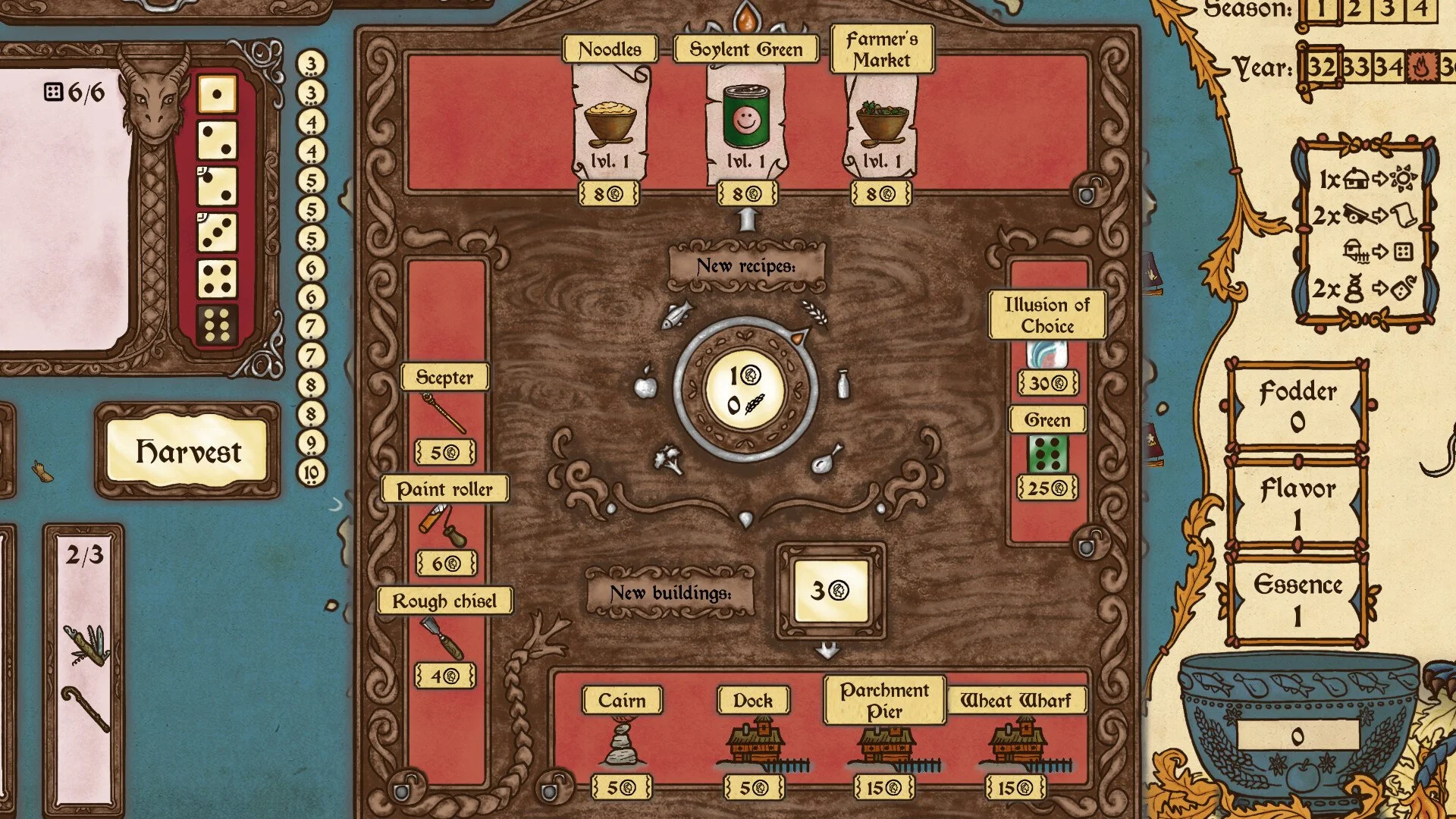
Image: Moravian / Indieformer
I'm not quite sure where Feed the Scorchpot sits within the roguelite landscape – it feels like Moravian have sort-of made a roguelike specifically for me and people like me, so I'm interested to see whether that lands with the wider roguelite community. For me, it's certainly my favourite in the last couple of years, so I hope that it does well and finds its audience, and that we can be treated to some more draconic feasts further down the line.
Feed the Scorchpot is awarded 8.5/10 by IndieLoupe.com.
The reviewed product was provided on by the publisher.
