
Review: Combolands
Last week I looked at a pretty excellent, pretty unique roguelike in Feed the Scorchpot – but it's not the only one I'd been playing recently. In fact, there were three that I was trying out, all of which were released in the last couple of weeks. One of those, for various reasons, is difficult to recommend and so I won't be covering here at IndieLoupe – but it probably wasn't helped by the fact that it was competing for my attention against Feed the Scorchpot and today's game: Combolands from Crux Games.
Perhaps I'm just particularly into island-set, turn-based, building-placement roguelikes… from two-person development teams… that I discovered during the Steam Next Fest, so take it with a pinch of salt (or spices, or herbs) but I think both offer something quite new to the genre. If you want to know more about Scorchpot then that article is there for you, but let's dive in with why I think Combolands is also worthy of your attention.
In Combolands players are tasked with settling on an uninhabited island and developing it from a dwelling, to a hamlet, to a village – all the way up to a thriving Metropolis. Over the course of the game's nine rounds, they'll have the opportunity to place buildings that entice more and more people to their growing colony, and hitting each population milestone will provide them with bonuses that help them on their way to that metropolitan goal. You're offered three buildings each turn and place the one that you think will benefit you the most: however, fail to hit one of those milestones within a certain number of turns – or weeks, in game – and you'll suffer the ignominy of defeat, presumably being hooked from your position as governor by the angry-looking fella in the crown for not being able to reach your goals.
-
Developer: Crux Games
Publisher: Crux Games
Release: 24 August 2026
Retail Price (Steam): 10,25€/$9.99/£9.09
One of the main selling points of the game is its guild system – there are seven in the game, each with their own set of buildings, and at the start of every island you'll pick two to make up the pool that is available to you for that run. You'll learn each guild's strengths fairly quickly, and as you get to see your new island before you select them, you're able to make an informed decision about which ones you think are best suited for each new settlement.
For example, if your island is covered in flowers or berry bushes you might consider including the Agricultural guild, who can make good use of those natural resources with their Apiaries and Picker's Huts. Perhaps you've got a large amount of forest that you want to take advantage of with the buildings within the Frontier guild, or a load of stone that you know will give points to the Barracks found in the Martial guild. It's rarely make-or-break: if you pick two random guilds (which, helpfully, the developers have added a button to allow you to do) your runs unlikely to be scuppered, but, particularly at the higher difficulty levels, it certainly helps to have some reliable gains coming in nice and early.
Naturally, with 21 pairs, some of those work together in a way that is more obvious than others, but in almost every pairing I've encountered I've found some way to combine my two selected guilds to create a unique interaction. That's obviously an intentional bit of game design – sometimes you'll discover a new building and it's relatively clear that its entire purpose is to work with things from another guild – but, even knowing that, the game does make you feel clever when you actually put it into action.
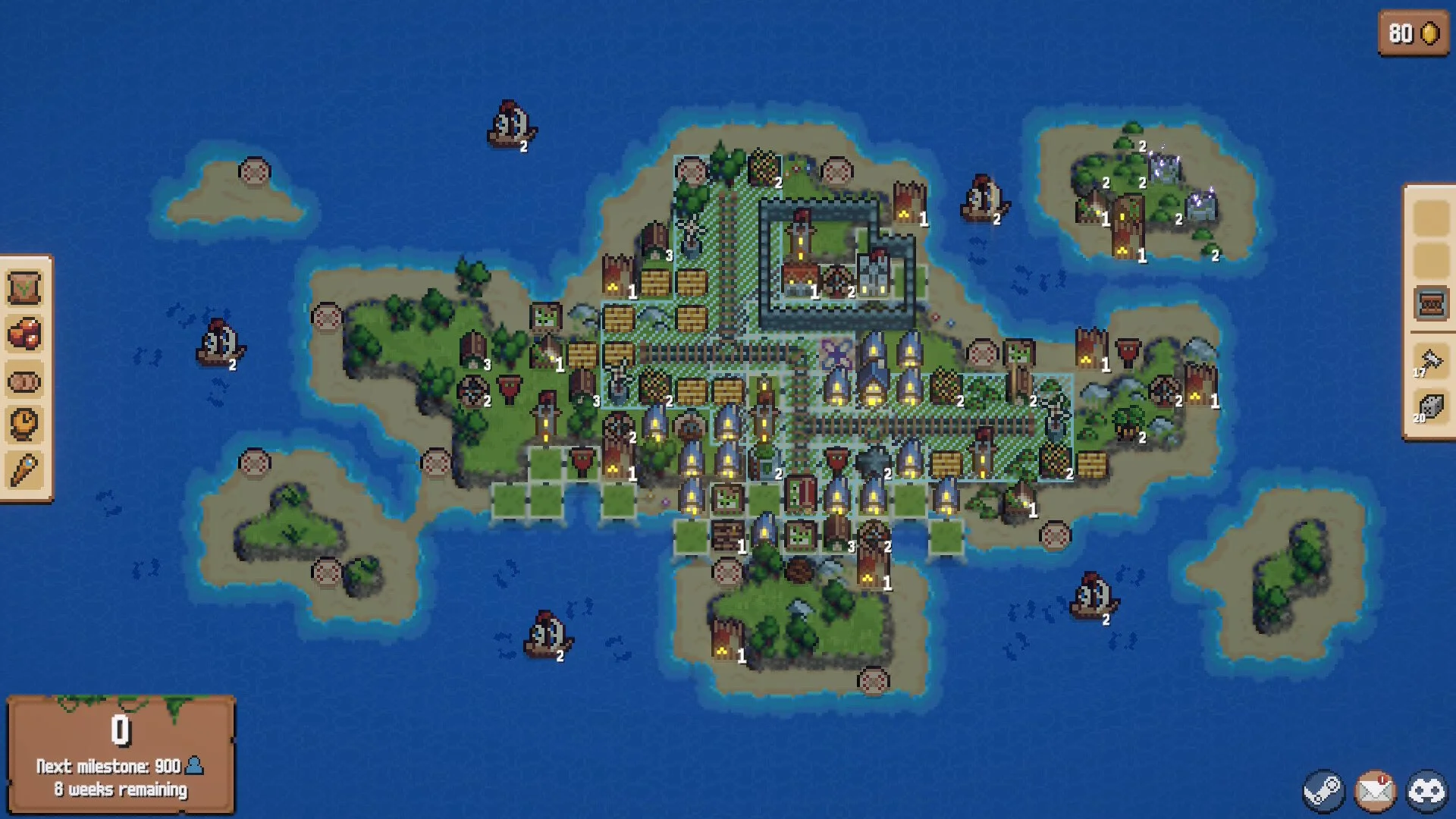
Image: Crux Games
There is a minor issue with the system, which is that you can often opt to neglect one guild more-or-less entirely if your strategy is better served by heavily focusing on the other. I've had a few runs where the 'secondary' guild was irrelevant and could have just as easily been any other guild, though it's worth noting that, when that happened, it wasn't determined until after playing a few rounds; I'd never go into a game thinking I was only going to use one guild – it would just end up shaping out that way. With a few different buildings offered in those early rounds, there's every chance that those runs would've instead been dominated by the guild I ended up not using, such is the way that you adapt to what you're offered and what you've already placed on your island.
Those runs, where you focus on one guild more than the other, are still enjoyable enough, but the most satisfying moments in Combolands definitely come from pulling off interactions between two guilds, to the point that I wouldn't have been against a mechanic that forced players into balancing their buildings between the two a little more stringently: perhaps framed as needing to keep both guilds relatively happy by ensuring you're utilising them both. Arguably that would go slightly against the game's vibe: the whole thing is pretty relaxing and stressing about upsetting some guildmaster or other might detract from that but maybe as an alternate game-mode, eh Crux?
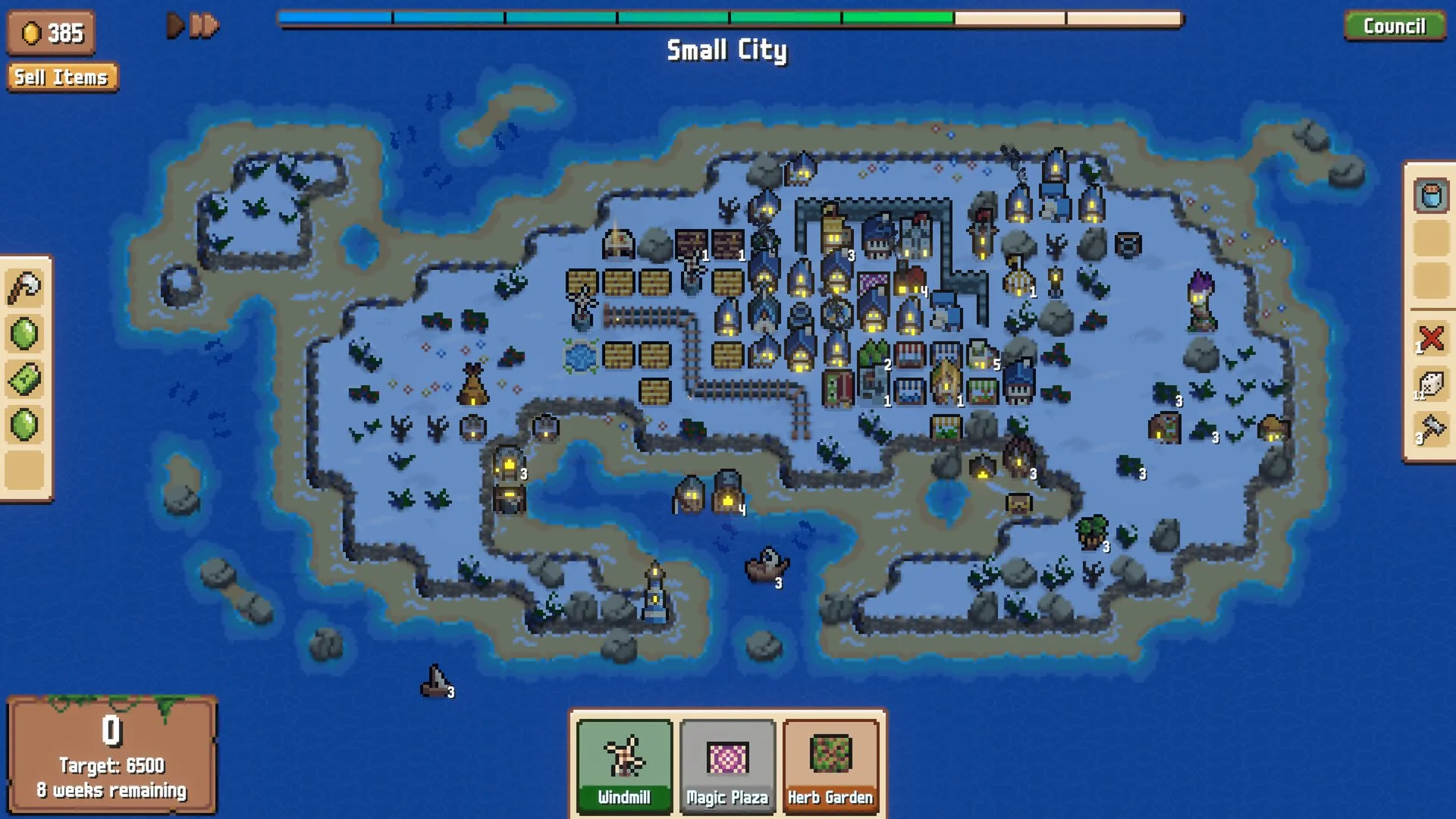
Image: Crux Games
On that relatively relaxing vibe, I'd say the difficulty here is pretty easy – I've so far found that I can usually put together a strategy that gets me through to that Metropolis, even on the highest difficulty levels. There are some caveats to that: I've not won with every guild combination and have started by ticking off the more logical pairings, so there's every chance that when it gets down to those less favourable combinations I might start having some problems, but my instinct is that that's unlikely to be the case. Again, it's probably not what Crux are aiming for with Combolands, but if you're looking for a real challenge you might not find it here.
To that end, the game feels very completeable: assuming you look to be as efficient as possible – as in, not playing again with a guild combination once you've won with it on the highest difficulty level (Regent) – you'll need 31 wins in total to get a gold medal next to each of those factions. The first ten of those wins are while you work your way up through the difficulty levels, and then, once you've done that, you've got your 21 guild combinations to complete. At the game's release that's pretty much all there is to do, but even if you're blasting through runs at some pace (and with the game speed set to max in the settings), I think that's at least 25 to 30 hours of gameplay, without ever feeling too repetitive. I'm personally a big fan of that: I think a lot of roguelikes have an overreliance on grindy 'content' that doesn't actually add much, and the slog involved leads to me bouncing off them pretty hard – I think it's a lot more likely that I'll see Combolands through to a 100% completion record.
That's not to say I wouldn't welcome additions to the game further down the line: I think there's decent potential for a well-designed guild or two to be added as DLC and, obviously, each additional guild would add more combinations than the last. I think you could get away with a handful of those before it would become too difficult to make the combinations fulfilling, but I'm sure I'd be happy for the excuse to load up the game again and try out some new strategies with some new buildings.
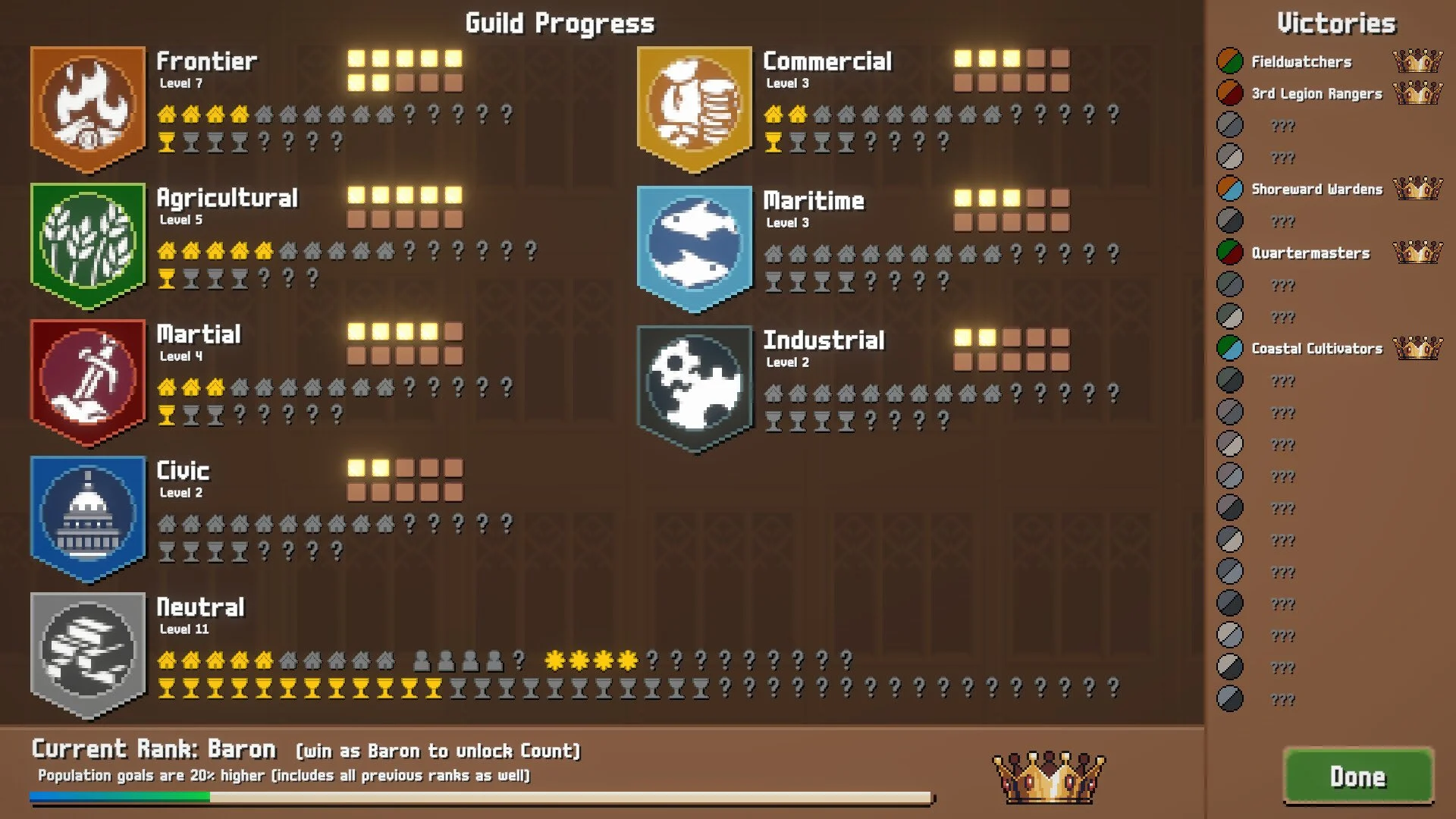
Image: Crux Games
But, before Crux starts thinking about adding any DLC to the game, there are few quality of life issues that I think could do with being addressed.
If you're a stats-nerd like me you'll probably be a bit disappointed by the lack of statistical offering: when you're selecting your guilds at the start of each run the game will tell you how many victories you've had with your chosen combination what difficulty your best win was on, but that's about it. Obviously not being able to see things like your overall win-loss record, or which building you've used the most, or what your highest ever score was, doesn't really impact the gameplay side of things, but there are some things which do: the most egregious one being the fact that there's no encyclopedia to speak of.
Again, right at the start of the game when you're selecting your guilds, you can see which buildings will be available and what they do, but after that there's nothing in-game to help with that. There's a thoroughly un-interactive 'Guild Progress' screen which will tell you which victories you've accomplished and if you've unlocked everything for a guild, but no way to check what those unlocks actually are. Once you've unlocked a few guilds there's a lot to keep track of – not just buildings but also over a hundred heirlooms and over a dozen councillors, each of whom provide five different levels of bonuses that you're just not able to see most of the time.
On one occasion I was desperately waiting for a particular building to come up to complete a little zone I'd been working on specifically with it in mind, but wasn't actually 100% sure it was in one of my two selected guilds: with no way to check, I just had to hope that I'd remember correctly. Luckily, in that instance, I had, but it would've been a massive source of frustration had I been holding out for something that was never going to come up.
There's are a few other little mechanics that help add a layer of strategy to the game, my favourite of which is probably the 'Dismiss' consumable which allows you to remove a building from your pool and prevent it from showing up for the rest of the run, but that has a similar problem in that there's no way to see what's actually left in your pool, which feels like important information to have.
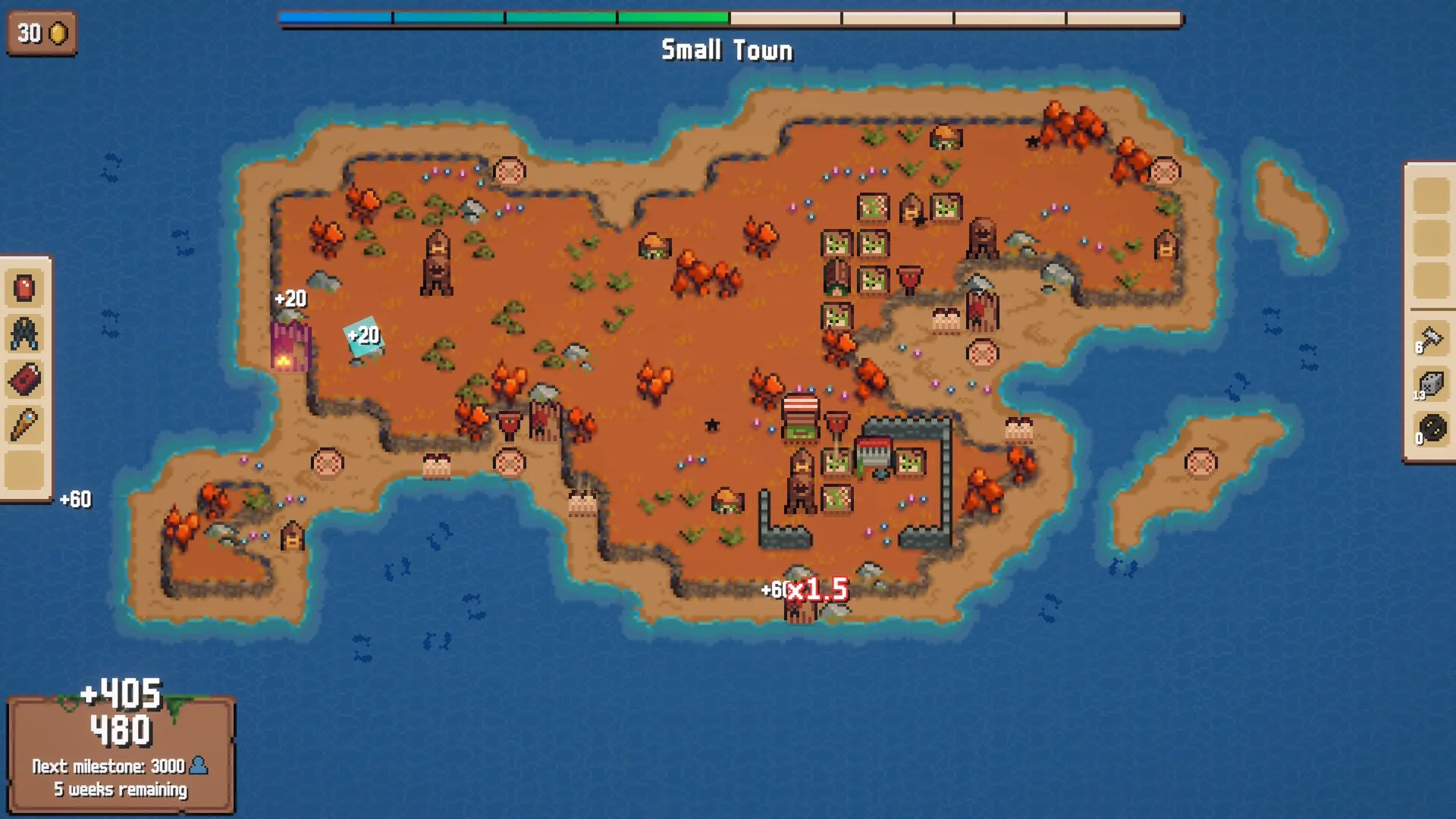
Image: Crux Games
In the end it doesn't have a huge impact on the game – as I've said, I enjoy it enough that I plan to keep playing it until I've checked off each of those victories – but an encyclopedia is something I would expect in pretty much any roguelike, and does feel like a layer of final polish which the game is currently lacking, so hopefully that gets implemented at some point in the near future.
I will go back, once more, to Feed the Scorchpot as I think it and Combolands happen to be such a complimentary pair to pick up together: Combolands for when you want something a bit quicker and a bit less arduous, and Scorchpot for when you want to, for lack of a better word, suffer, and I've really enjoyed alternating between the two over the last couple of weeks.
For Combolands I 'm curious to see what, if any, additions are made to the game because I think there's a lot of potential here for further difficulty options, more game modes, new guilds… a bloody encyclopedia… and would definitely come back to the game for each of those – but, as it stands, it's still a wonderful little game that I've had a lot of fun playing.
Combolands is awarded an 8/10 by IndieLoupe.com.
The reviewed product was provided by the publisher.
—
27/08: An update that added an encyclopedia (or 'Compendium', in-game) was put out around the same time as this review, and that also tracks discarded buildings – so most of the quality of life issues mentioned have already been addressed, in case that's holding anyone back. Happy Combolanding!
