
Early Access Preview: Moves of the Diamond Hand
I don't think anyone, fans or otherwise, would accuse Cosmo D of being a regular game dev. When his first paid title, The Norwood Suite, came out almost a decade ago it took me a while to pay it any sort of mind; I'm fairly certain I saw it, glanced at some of the screenshots and – I now know, naively – dismissed it as an ugly mess of a game which I'd have no interest in playing. Somewhere down the line it wormed its way into my Steam library (if you must know, I'm fairly certain through the February 2018 Humble Monthly Bundle) and sat there unplayed for I don't-really-know-how-long.
At some point – I can discern between the release dates of two of his other games (15th May 2020 and 9th September 2022) – presumably bored out of my mind on some evening where I had nothing else to play, I finally took a punt on it. I can't say why. Because it was already there, because it had good reviews, because it was nice and short – whatever the reason, I played it, and I really enjoyed it.
I went and got the next game Tales from Off-Peak City Vol. 1 almost immediately and liked it, I waited for the next game The Betrayal at Club Low and… sort of didn't. There are reasons for that which I will sort of get into, but, whatever, one small blip, still appreciate his work and the world that he's been building. And now we've got the fourth title (or fifth, if you include the free, debut, game Off-Peak) in the Cosmo D Cinematic Universe: Moves of the Diamond Hand – at least, in early access. And if you want an indication of my excitement for this game then that's probably a decent one: usually I won't touch early access titles, certainly not for the website, but, here I'm making an exception. So, here are my impressions of my first taste of Moves of the Diamond Hand.
Image: Cosmo D Studios
-
Developer: Cosmo D Studios
Publisher: Cosmo D Studios
Release: 13 April 2026 (Early Access)
Retail Price (Steam): 19,99€/$19.99/£16.75
If you just look at any previous Cosmo D game you'll immediately notice that Moves of the Diamond Hand shares a lot of similarities with them – they're kinda like Wes Anderson movies at this point, where you can just look at one and know who made it – but on the surface it looks most similar to Betrayal at Club Low, which you'll recall I was pretty lukewarm on. Not the best first indication, but the two things I liked least about that game have been stripped away.
Firstly, while Club Low was not exactly a roguelike – a genre which I have a turbulent relationship with – it certainly had those aspects to it: where you're going through a run and can fail and have to restart from the beginning, and you get a score of sorts for that run displayed against your records from previous attempts. Secondly, it had this whole third-person semi-on-rails thing to it, which felt like the opposite of what I'd come to expect from a Cosmo D game: I want to explore his bizarre world freely, wander about the place and interact with whoever I choose – whereas this felt almost like a digital choose your own adventure novel, where you only have a handful of options from any given position.
I can sort of vibe with that, but it didn't feel very 'Cosmo D': it felt restrictive to what his previous games did best. For what it's worth that's probably just me: it was incredibly well received – but luckily for me, here in Moves of the Diamond Hand we're back to that first-person exploration, and back to a single open-world RPG where the game isn't expecting you to replay the content in the way Club Low arguably did. Not that there isn't a lot of replay value: having played through to the finishing line of what's available in the current iteration of Early Access, there are already a lot of paths that I didn't explore. There's a main mission that can be approached in no less than seven different ways, four of which are currently available: I followed one of those, dabbled in another, and didn't touch either of the other two.
So I said that there were a lot of similarities between Betrayal at Club Low and Moves of the Diamond Hand but then only mentioned how they differ: so what exactly are those similarities? Well, the world its set in and its off-kilter aesthetic is the same as every other Cosmo D game, but specific to Club Low is the main gameplay mechanic, which is replicated here: almost every interaction in both games relies on you rolling your 'Skill Dice' against another dice – sometimes that's a person and their own abilities, sometimes it's an object, sometimes it's just the environment.
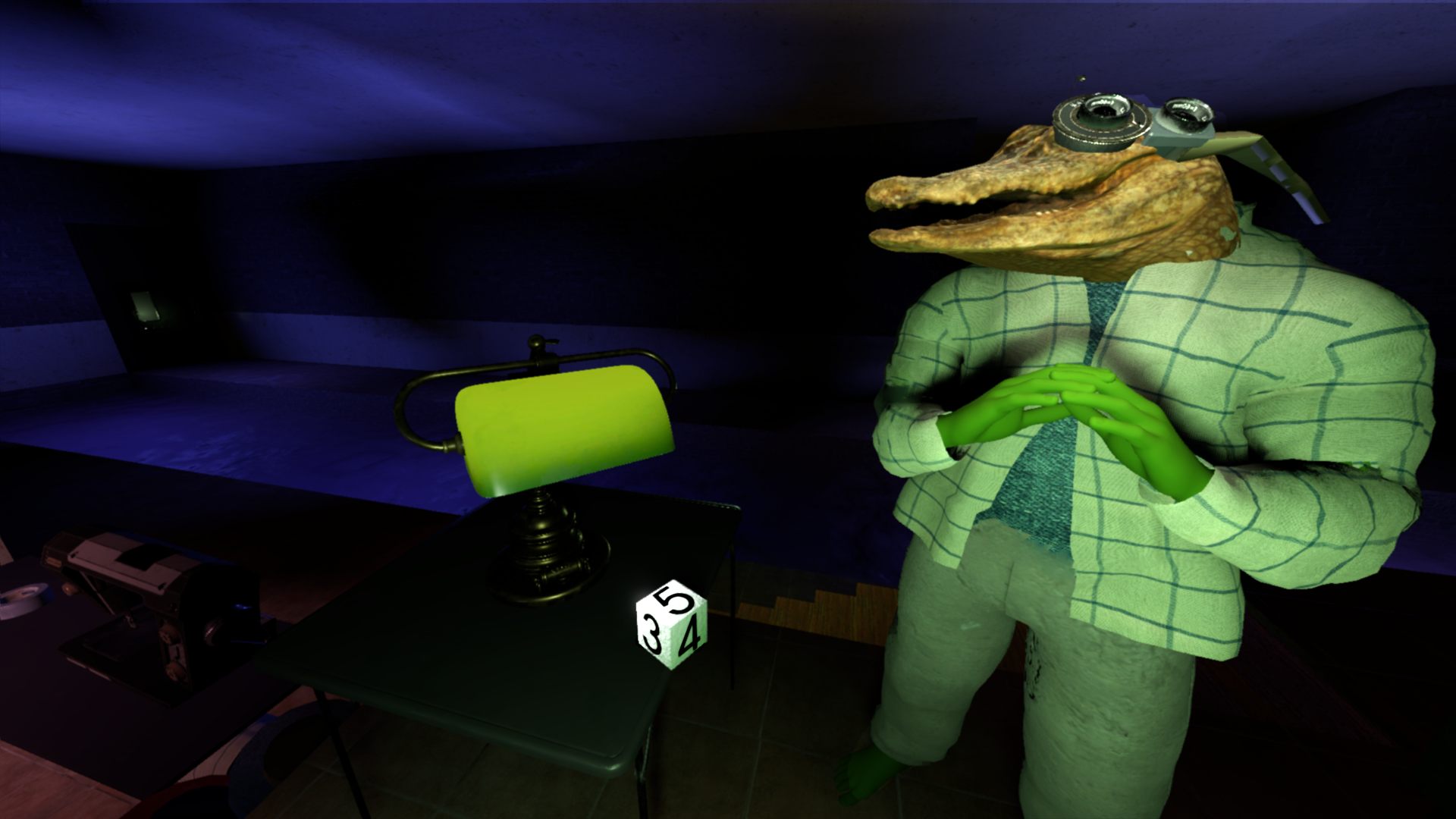
Image: Cosmo D Studios
You have seven different skills: some more typical for an RPG, like Wisdom and Physique, some less typical, like Cooking and Music. Again, these seven skills are the same seven that were in the previous game, but given the much larger scope there's a lot more breathing room for them to develop more unique flavours. There are some interactions that you'll encounter relatively frequently and are unique to one given skill: if you want to cook a pizza you're always going to be using your, surprisingly enough, Cooking skill; if you want to pickpocket someone – something you can attempt with almost anyone you can stand behind – you'll need to use your Deception skill.
All those skills start out incredibly weak: your dice begin with three faces with zeros on them, and three faces with ones on them: numbers which will fail all but the most simple of tasks. You upgrade these with experience points that you earn for pretty much everything throughout the game, with each upgrade costing more than the last: to change a 0 to a 1 it costs 3 experience, to change a 1 to a 2 it costs 6… and those numbers start to get pretty big pretty quickly.
Balancing how you advance all your skills is extremely satisfying: the strategy behind it is probably my favourite part of Moves of the Diamond Hand, and the game offers a lot of different incentives which compete with one another for where you put your points. Even when you know which skill you want to work on, you have to consider how balanced you want to make its die; how many sides you want to improve. Are you going to just push two or three as high as possible and hope you roll them, or play it safe and advance more sides, but to a slightly lower extent?
Beyond that, you've also got bonuses which unlock after particular milestones (once you've invested a certain amount of experience into a given skill), and powerful items called disguises – effectively what your character is wearing – which you can only equip once you've levelled up certain sides on certain dice to certain numbers. Disguises are just one of many items available which provide additional 'side-dice' to help tilt the odds in your favour: it's very rare for you to just have a flat roll where you're putting a single die up against another.
There are also statuses that you're constantly obtaining that will provide a side-die on your next roll: these can be good or bad; often they're a mix and you're at the whims of how you roll. If you barely succeeded with your previous roll you'll get 'Too Confident' which can help or hinder, go digging in a bin for items and you'll smell of trash, which is… less likely to help. The whole thing sounds (and I think looks, when you're not used it) a little convoluted, but everything is introduced to players in a very clear and organic way. That's not to say there aren't gameplay decisions I wouldn't make differently if and when I start a new playthrough because, as with any RPG, there's a learning curve that you can only really get over by playing it for a little while.
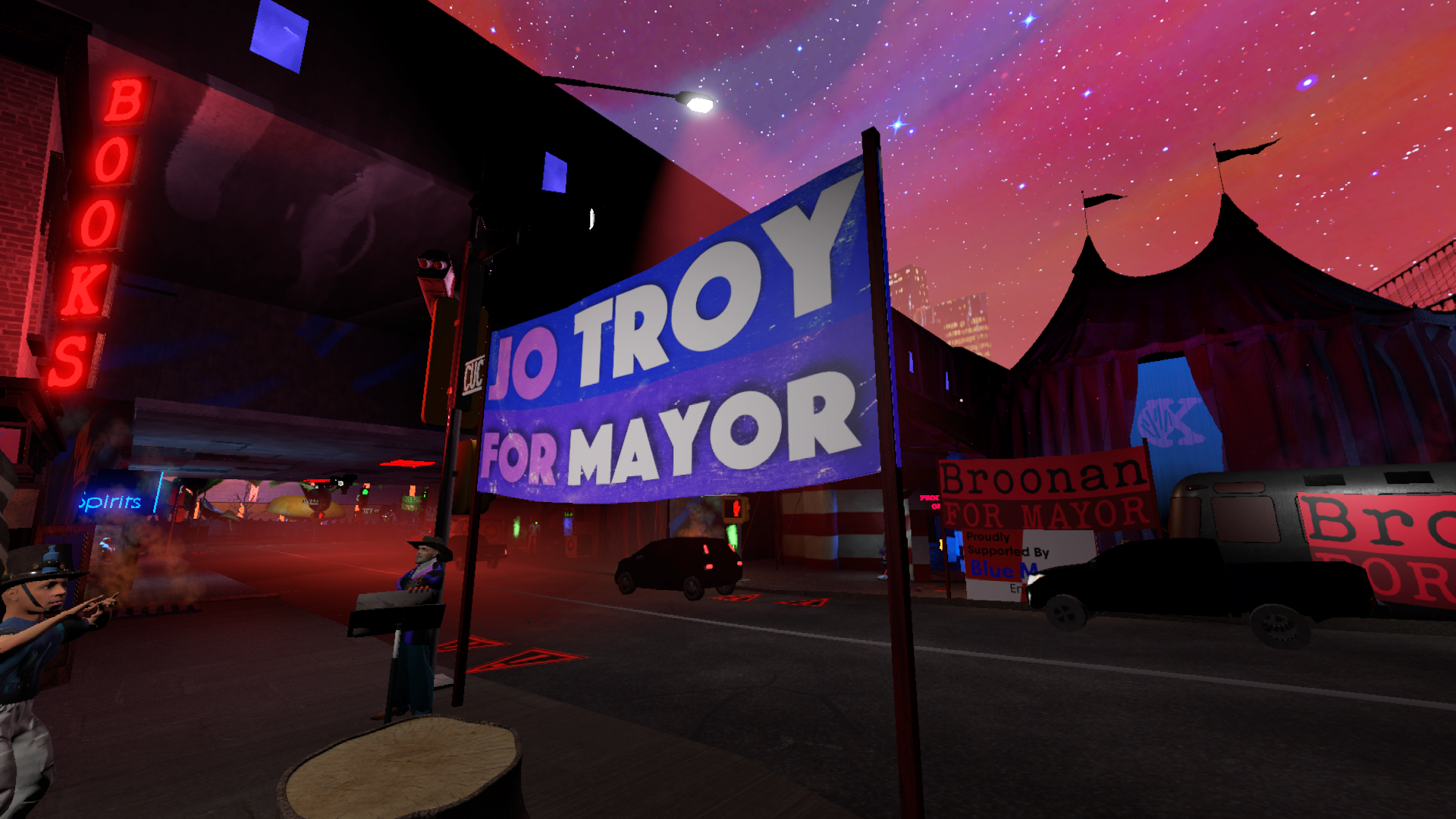
Image: Cosmo D Studios
It's a little difficult to fully assess the game's story while only having access to the first two of five chapters, but I've enjoyed the setup so far and am looking forward to seeing where it's headed. I think your character's own motivations are a tad flimsy: it's immediately apparent that you have some great desire to join the circus – 'Circus X' – but the nature of that organisation is, intentionally, left very vague. In my main, 8-hour, run of what's currently available, I didn't learn much more about them: I probably could have if I'd sought it out, but I was occupied chasing the strands that were more interesting to me.
Strangely enough, there's another game I've been thinking a lot about recently where the main subplot is an election and the political intrigue surrounding it – much, much, more on that in our next video exclusive – but here in Off-Peak City you're also immediately thrust into a similar situation. You've a brief introduction to the game's mechanics and that personal goal of yours, but then you step out into your first 'hub', the train station, where there's an ongoing situation affecting one of three mayoral candidates. Your personal goal takes a back seat to that and, for me at least, it more-or-less stayed there. It was easy to forget what my driving force was supposed to be and instead follow that, more interesting, part of the story.
That's not necessarily a bad thing, and there's plenty of time to pick it up further down the line, but there were a couple of occasions where I found myself being reminded of Circus X and thinking 'oh right, yeah, that's what I'm supposed to care about'. I don't want to make it sound like those two areas are completely independent of each other, because they're actually heavily intertwined: you getting involved in those political machinations is in service of that ultimate goal – the idea being that, for example, if you make some powerful friends they might be able to aid you in your own ambitions.
I mentioned earlier that there are seven different ways you can approach that goal, and each is tied to one of the attributes, offering a different avenue into Circus X: maybe you'll use your Wisdom and join the city council, maybe you'll use your Music and join a band that they'll have to accept as performers, maybe you'll use your Cooking and just try and make them a real nice sandwich. In terms of how the game shapes out upon its full release, the thing I'm most curious about is whether each of those paths can be pulled off in a way that feels unique and fulfilling: if each feels like a legitimate option and just how different their stories end up being.
Image: Cosmo D Studios
I do think it's all pretty ambitious – I've seen an Early Access Roadmap which very much corroborates that – to the point that I'm gently sceptical of the development timeframe: not that I don't think they'll eventually achieve everything they're setting out to do, but I wonder if it won't take a little longer than expected. Obviously I have no idea how much of the content that is yet to be released is also yet to be made, for all I know Cosmo D is sitting on almost-complete versions of the upcoming chapters, but regardless of how long it takes, I'm looking forward to seeing where it goes next.
I'll definitely be returning to Off-Peak City, though I'm not sure if I'll do that until that full release comes about. That's not an indication of the quality of the game but rather my own preferences of avoiding Early Access – really, the fact that I made the exception and played it now, and did so for so long, should tell you everything you need to know.
The reviewed product was provided on behalf of the developer.
