
Review: Piece by Piece
I'm a little late on this one, as Piece by Piece actually came out a few weeks ago now: the same time as I opted to review Rhell: Warped Worlds and Troubled Times. In that article I mentioned that, for that particular week, I struggled to pick which game to look at as there were a lot of titles competing for my attention: and among them was Piece by Piece and… um, Piece by Piece.
Two games with the same name, released 48 hours apart. While I won't deny that coincidence brought about my initial interest in those games, it would be dismissive to say that's the only thing worth noting about them. So, here's our (slightly late and shorter-than-usual) review about one of those Piece by Piece-s.
Image: Neon Polygons
-
Developer: Neon Polygons
Publisher: Neon Polygons
Release: 13 March 2026
Retail Price (Steam): 12,79€/$12.99/£10.99
It's been a while since we reviewed what I'd call a 'pure' puzzle game – one which may have a modicum of story to it but is largely just you running through a set of levels – in Piece by Piece's case, exactly 100 of them. There's hardly any fluff: finish a level and it's onto the next, finish a set of levels – in this game's instance known as a 'puzzle box' – and you can unlock another and crack on with more puzzly goodness.
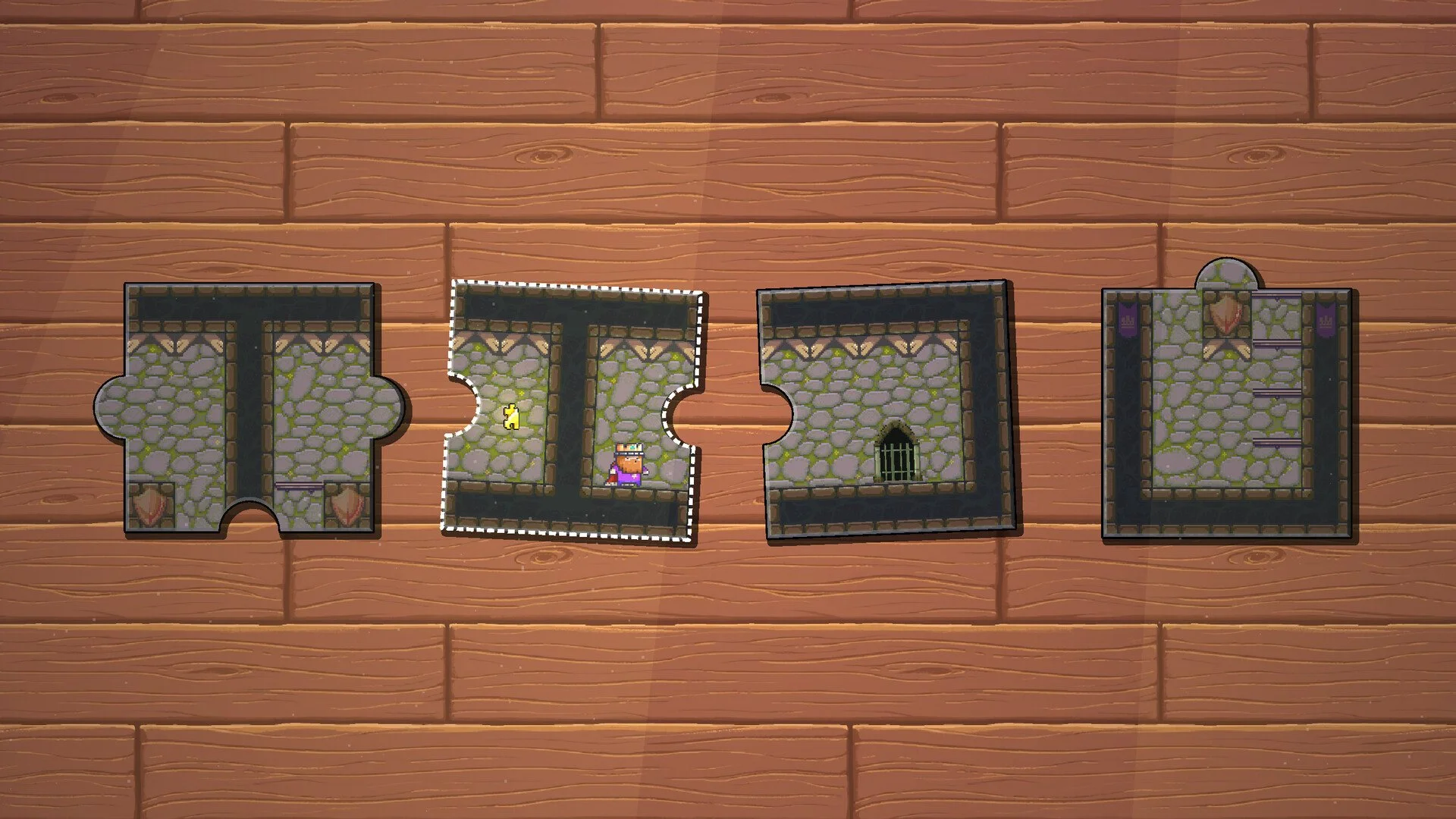
Image: Neon Polygons
At the very start of the game you'll only have one box available ('King's Quest') and upon opening that you're presented with what appears to be a fairly straight-forward, and incredibly literal, puzzle platformer. There's three puzzle pieces on your table, one with a little king on who can run around the tile. You can just link those three together (this is level one, after all) and run him straight over to the exit to complete the mission.
There is, however, also a golden puzzle piece on one tile which you'll want to send the king to collect, and to do that will require a little more maneuvering: you'll need to connect two tiles, run between them, disconnect them and then connect the third tile in place of the first. Then you'll have the puzzle piece, but will need to rearrange things further in order to reach the exit. Still relatively straight-forward, but again, still level one.
Collecting those puzzle pieces is technically optional, but you do need to get most (if I'm not mistaken, 80%) of them to unlock future puzzle boxes, and I ended up playing through the whole game as though it were necessary; there wasn't a single occasion where I moved onto the next level without having grabbed the golden puzzle piece first. Arguably I could've saved myself a couple of headaches if I'd just left them and come back later on to look at them with fresh eyes, but the perfectionist in me wouldn't have stood to see an ugly gray sticker on the boxes when I knew there was that shiny gold one available.
At this point, you may be wondering how running around some tiles while connecting and disconnecting them could possibly remain engaging for 100 levels – and the answer is that it probably couldn't. The King features in the first first ten levels and is limited to just those mechanics, the Queen appears for the next ten and introduces one additional, minor, rule to the game. After completing her puzzles is where this game really begins to shine, with no less than six additional characters unlocked, all with their own rules.
These include a robot with rotatable puzzle pieces, a demon with flippable puzzle pieces (showing, fittingly, an angel on the reverse side) and a driller who can only move in straight lines through certain areas. Each of the six characters come with a small puzzle box of their own, but things ramp up even further when those mechanics are combined in later packs.
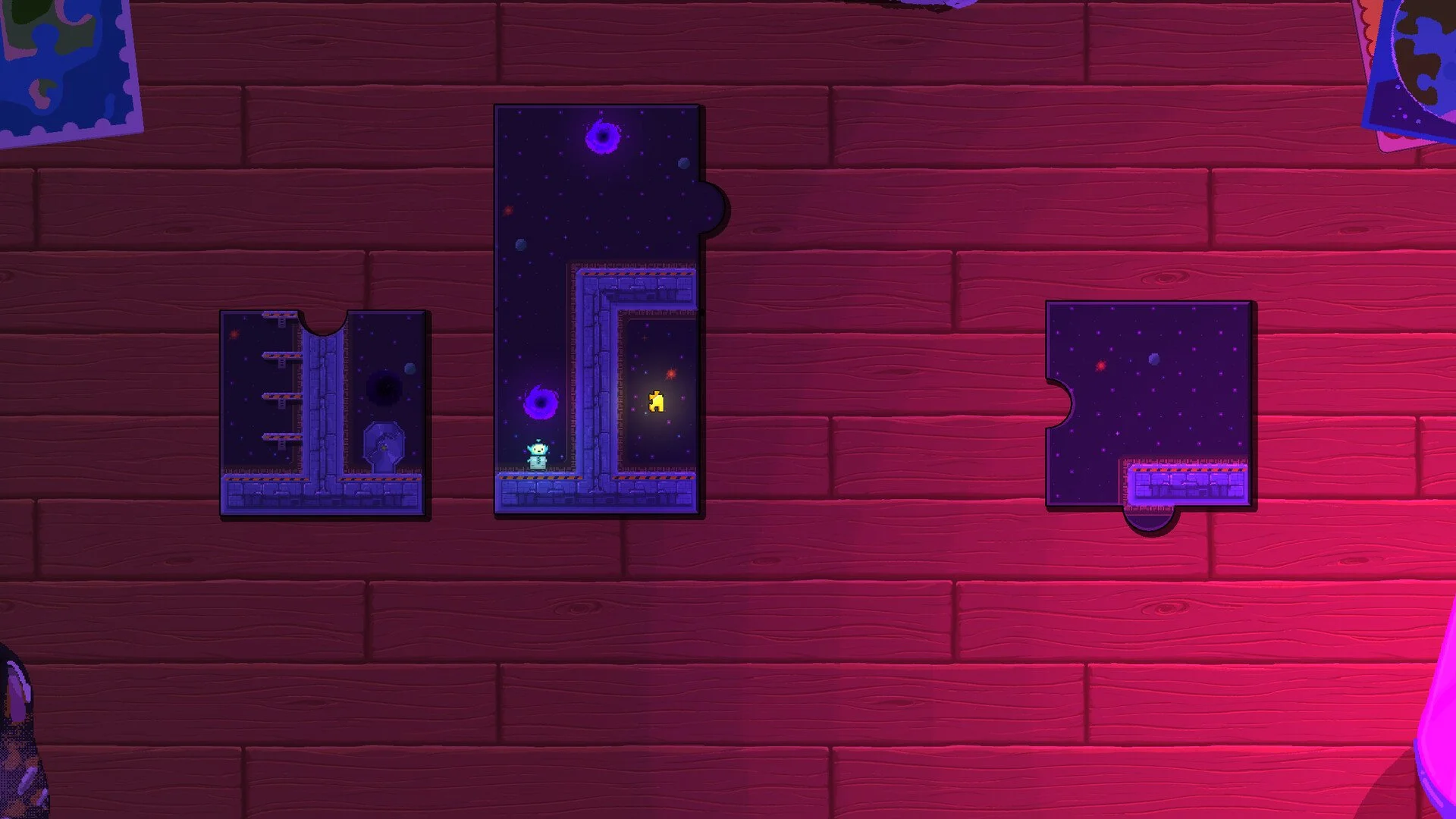
Image: Neon Polygons
I blasted through the first fifty levels of Piece by Piece in about as many minutes, though that does depend a little on how you approach the game, as you don't have to complete things in the same order I did. For me, after those first 20 levels I moved onto each of the small 5-level puzzle boxes before touching any of the combined puzzles, which are significantly harder – it took about three times longer for me to complete the second half of the game than it did the first, for an overall experience that lasted about three and a half hours.
That increased difficulty rarely led to frustration: Piece by Piece is very tactile so it's pretty satisfying just shifting pieces about. Even when you're a little stumped it's easy to experiment, and I won't pretend there weren't times I stumbled into a solution just by erratically connecting pieces here and there until things fell into place. I doubt that's a strategy that always works, arguably I might've solved some things faster if I'd just sat back and looked at them for a little while, but it is fun messing around with things.
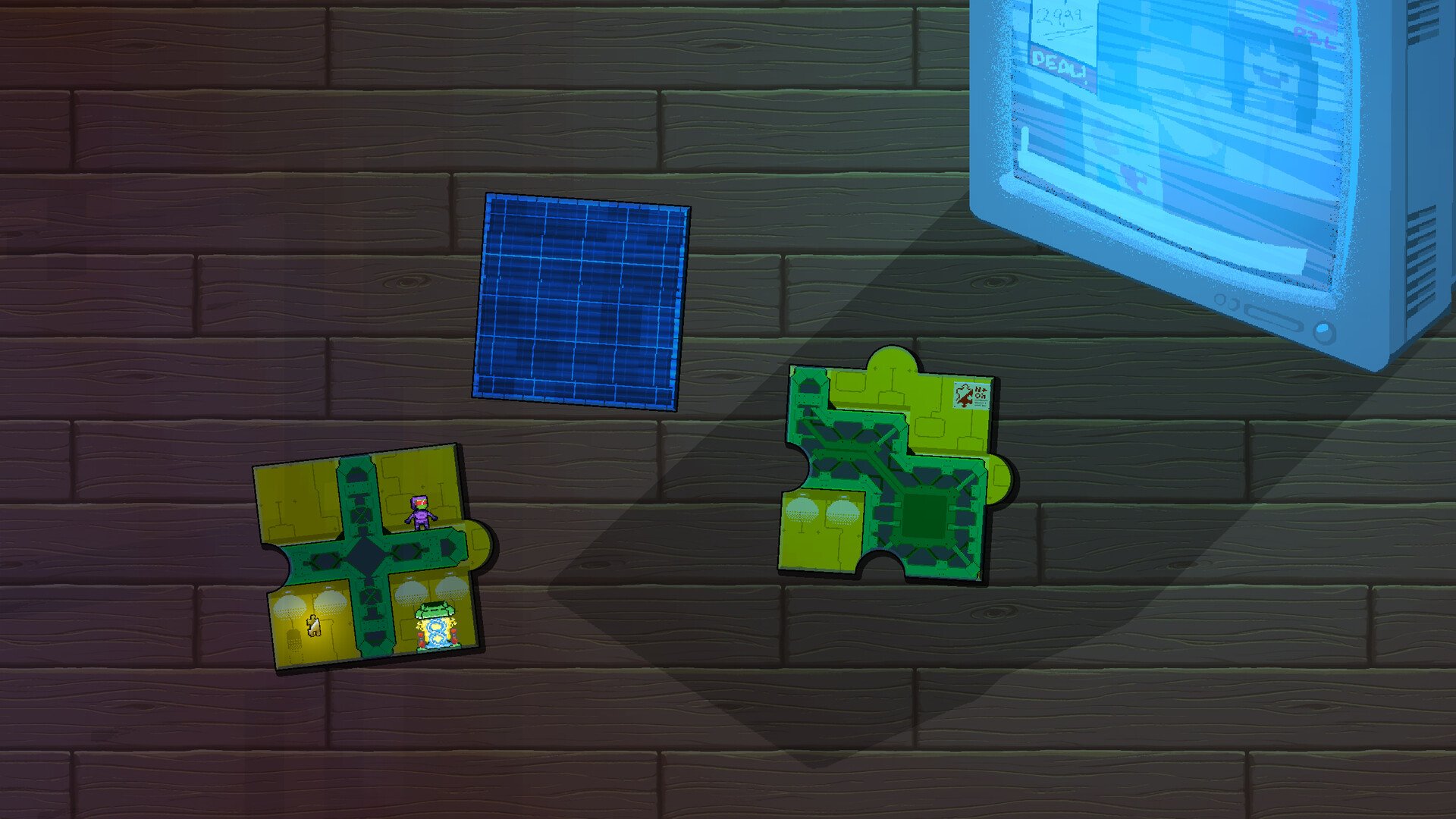
Image: Neon Polygons
There was one of the six mechanics which on the surface seems pretty basic – it's just a piece which you drag over another to create a clone of it – but which I did get frustrated with; I found it was almost always present on the puzzles I'd get seriously stuck on. I'm not quite sure why that was; it often requires you to clone multiple different pieces in one level, so perhaps I found it more difficult to visualise the way everything could fit together, but I have to admit I'd breathe a sigh of relief when a new level would load up and it wasn't present. I did play the whole thing in one sitting and I was trying to rush through it, so that might have exacerbated the problem, but there were a couple of occasions where I found myself longing for a hint system of some description.
In spite of that, I had an excellent time with Piece by Piece, and consider it a solid entry into the puzzle genre, with well-designed puzzle across the board and an almost perfect difficulty curve.
It is awarded an 8/10 by IndieLoupe.com.
The reviewed product was purchased by IndieLoupe.com.
