
Review(-ish): The Red Pearls of Borneo
I’ve got a bit of an odd one today, a review-ish, if you will, of an entirely free game: The Red Pearls of Borneo from hobbyist game developer Bushmonkey. I call it a review-ish because, while I will cover it in as much depth as any of our other reviews, there will also be some wider ruminations on stuff outside of the game itself – mainly the nature of free games – which is certainly of interest to me, and hopefully to you too.

Image: Bushmonkey Games
-
Developer: Bushmonkey Games
Publisher: Bushmonkey Games
Release: 30 January 2026
Retail Price (Steam/itch.io): It’s free!
I suppose I should start by admitting my own scepticism surrounding free video games. I’ll try to avoid digging into the minefield that is pricing a game, but, rightly or wrongly, my brain tells me that if it doesn’t cost anything, then it’s not likely to be worth anything. We can probably thank capitalism for that, but I would say my lived experience with free games does somewhat corroborate it.
The only things I tend to make exceptions for are daily games (like Jamwitch’s The Daily Spell which, no bias, had an excellent guest writer last week) or bite-sized experiences like Jamwitch’s My Friends the Monster Trainers or… Jamwitch’s The Case of the Dungeon Descent.
And yes, ‘haha funny joke,’ I used the same developer three times there, but what it betrays is my total lack of reference points within the modern ‘free game’ landscape. I did try to dive into some longer titles after playing The Red Pearls of Borneo – which itself took around five and a half hours to complete, including additional content – but, if I’m being entirely honest, couldn’t find much else to persuade me against the notion that you are typically getting what you pay for.
I don't say that to dunk on free games – I'm sure there are more out there that I'd enjoy if I found them – but because I suspect it's probably a pretty commonly held belief, and, even if you feel that way too, I think The Red Pearls of Borneo is worthy of… well, not your money, it’s not asking for that… but your time. I mean, we’ll get into the fact that it would be worth your money too, but I suppose the headline, the takeaway, is that I’m not saying: ‘this game is fantastic – asterisk –for a free game’ but that this game is just fantastic, no qualifiers: my favourite game of the year so far.
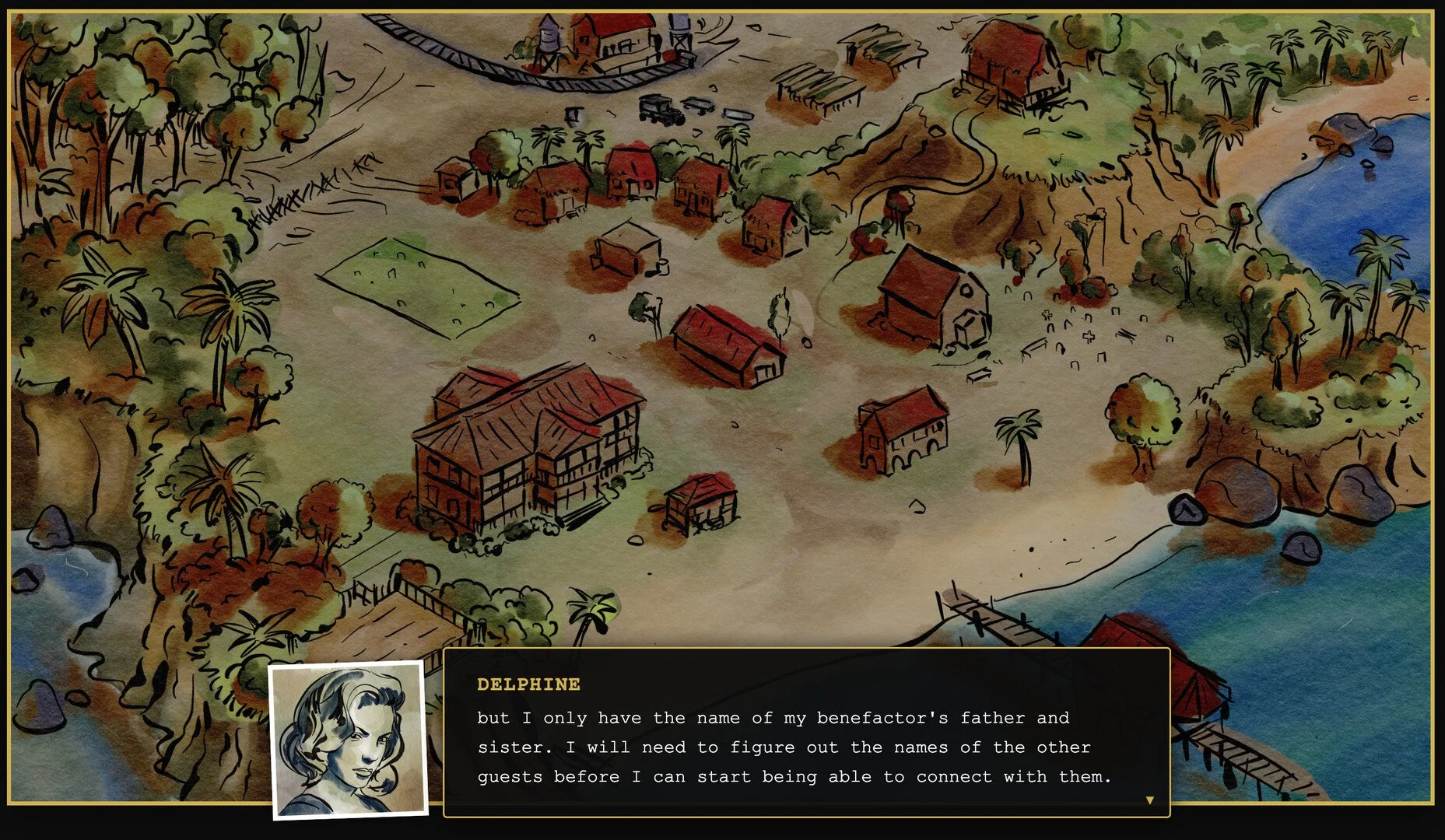
Image: Bushmonkey Games
In The Red Pearls of Borneo you play as Delphine, a 'Sensitive' – effectively a physic detective – who's been hired to investigate the events that took place on a remote plantation in Borneo on 16th December 1941. All accounts indicate everything was fine on the morning of that day, but by the 17th December, everyone who had been there was missing, presumed dead. Nobody knows what happened to them, and given the geopolitical climate in 1941, nobody ever found it.
The problem is that, that was seven years ago and Delphine is halfway round the world in London, but luckily, with her abilities, that’s not as large a barrier as you might expect. Armed with nothing but an unlabelled map of the plantation and a collection of portrait photographs, you, as Delphine, will aim to map out a complete version of events for each person who was on the plantation at the time – around a dozen people – from the early afternoon of the 16th to the early afternoon of the 17th.
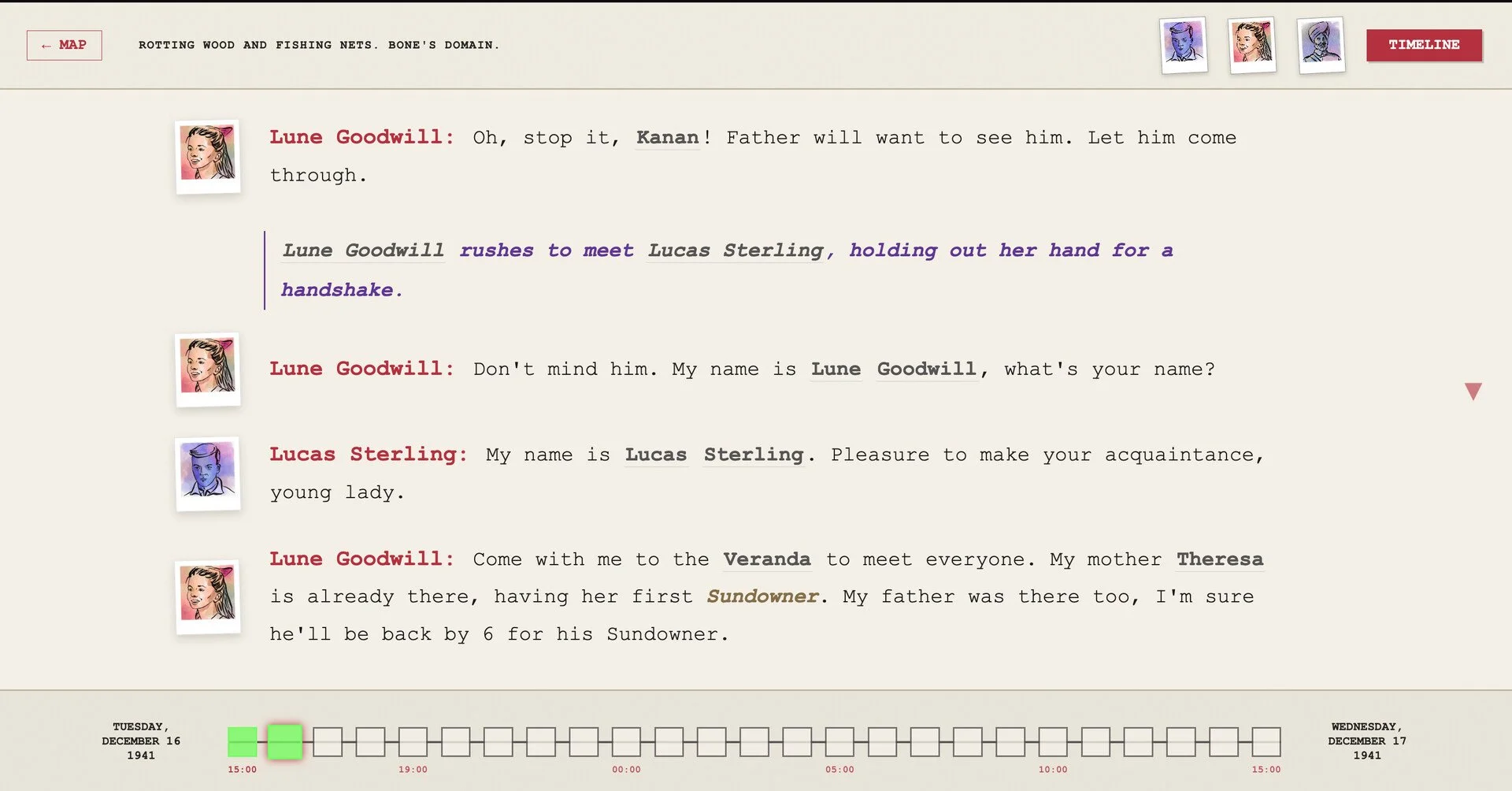
Image: Bushmonkey Games
The only way to get a complete vision of what occurred in a given location at a given time is by selecting that location and time, and the exact people who were present. For example, the only information you have to go on initially is that Jeremiah Goodwill, the plantation owner, was alone in his study at 4pm – so at the start of the game you'll focus on the study, focus on 4pm, select Jeremiah (and only Jeremiah) and, hey presto, you'll get a little scene of old Jerry making a telephone call.
That needs to be precise. If there were four people in a room and you selected three of them and attempted to focus, your vision would be unsuccessful. You’d need the fourth. While that can already be quite difficult, it’s made even harder as you start knowing only who Jeremiah and one other person are; before you can assign any of the other people who are photographed to a room, you need to figure out who they are.
For that part – unless I missed something obvious – there is more guesswork involved than games like Return of the Obra Dinn or The Roottrees are Dead. In your first vision, for example, you'll learn that someone is called 'Lucas Sterling' but even if you’re going to indulge in a bit of… er, racial profling… which of three people that might be is not entirely apparent. You can often make an educated guess, and your educated guesses are, more often than not, going to be correct, but on a few occasions you might need to assign a name a couple of times before you correctly identify them. If you’ve played a lot of these sorts of games, you might have to ‘untrain’ yourself from thinking that’s cheating or brute-forcing it in a way you’re not supposed to.
By intention (again unless I’m missing something obvious), there are occasions when you’ll know, for example, that two characters are alone together somewhere at a particular time, but have to try out a few locations before you nail down the right one. It’s very rare for that to be a case of just trying everywhere; there will only ever be three or four places that are plausible, and eliminating the incorrect ones makes thematic sense here: Delphine is trying to focus on an event that didn’t happen and so can’t get a vision. What’s more, if nothing happened in a room at that time, the game will tell you that, again framed within the psychic aura that Delphine is picking up being so faint that she can establish there was nothing going on at that time.
There is one final way you can get glimpses of what happened in a room without needing to know everyone that was present, but I’ll leave that for you to discover yourself. I have to admit that all those aspects combined meant it took me a little while to get the hang of everything: early on when I hadn’t figured out who many of the characters were and was less familiar with the game’s systems, there was an occasion or two where I struggled with knowing what to do next, but after I cleared those early hurdles it was pretty smooth sailing. The game has some excellent ways of accessing various timelines, for both rooms and people, so despite having a pretty large amount of information to keep track of, it never gets too overwhelming; it’s very easy to find where you’ve got gaps, and to start looking around those for clues.
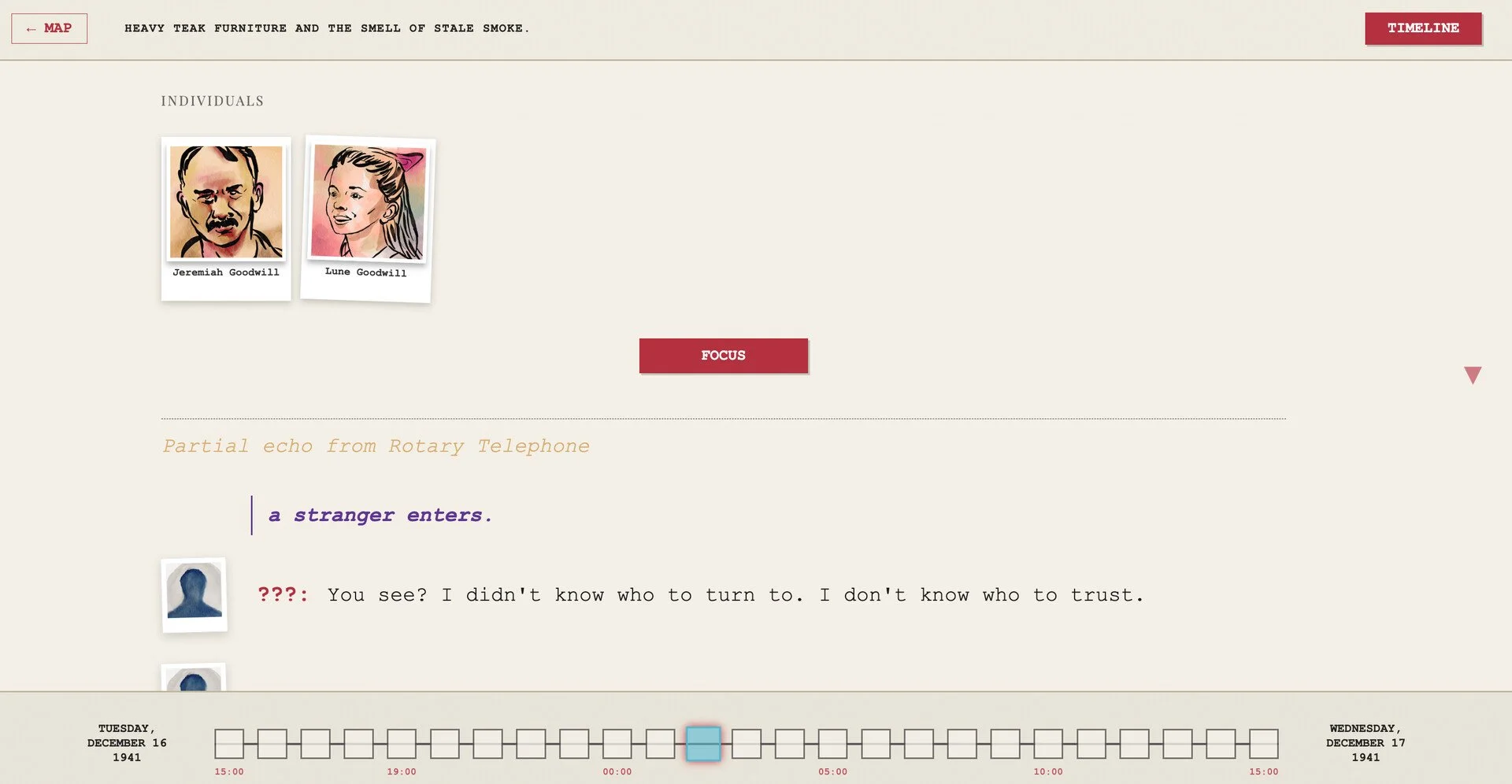
Image: Bushmonkey Games
I mentioned back in my TR-49 review that with these ‘narrative deduction’ games I think striking the balance between those two aspects – narrative and deduction – is difficult: for my tastes, The Return of the Obra Dinn is the only one that has, historically, done it perfectly. For TR-49, as much as I enjoyed it, I felt the deduction side of things came up a bit short – I never really felt challenged – for others, I really enjoy the way the deductions work, but then find myself indifferent to the story being told. One part invariably feels secondary to the other: it’s either a narrative game with deduction mechanics included, or a deduction game being propped up with a story that mainly serves to facilitate those deductions. Which is fine, they’re still my favourite genre at the moment, but the ‘holy grail’ is one that manages to do both.
And for me, The Red Pearls of Borneo does. When a deduction was straight-forward – which is inevitable in places, as there’s something like 100 scenes in the game – I didn’t mind because I was engrossed in the story, and there were certainly enough times that it wasn’t so obvious which kept my brain ticking over. You might have occasions where you can chain a few events together relatively quickly, but then you’ll need to go away and dig around to find the next block of the story. I found the ebb and flow of that incredibly satisfying; a few easy tasks – uncomplicated but still engaging – then a nice tricky one, then back to some easier ones, and so on.
If I’m looking for something to pick at, then perhaps that’s the reason there was one part of the game I didn’t enjoy quite as much: after you’ve completed the main story there are no less than three smaller, side-stories. They all use the mechanics of the main game, but two of them include basically no deductions: they’re each just a long chain of events. They’re both well-written, but I was so securely in the ‘I’m deducing things’ mindset, having spent the previous four hours there, that it felt a little jarring to then be in what was more-or-less a linear visual novel. I guess the best analogy I can draw is that it was like when you’re really enjoying playing a game and then suddenly you’re in a 20-minute cutscene: you can appreciate that it’s good, but it’s not necessarily what you want to be doing right at that moment. I’m still happier for having played them, I think they’re worthwhile additions that benefit the story, but I do think they feel slightly at odds with the rest of the game.
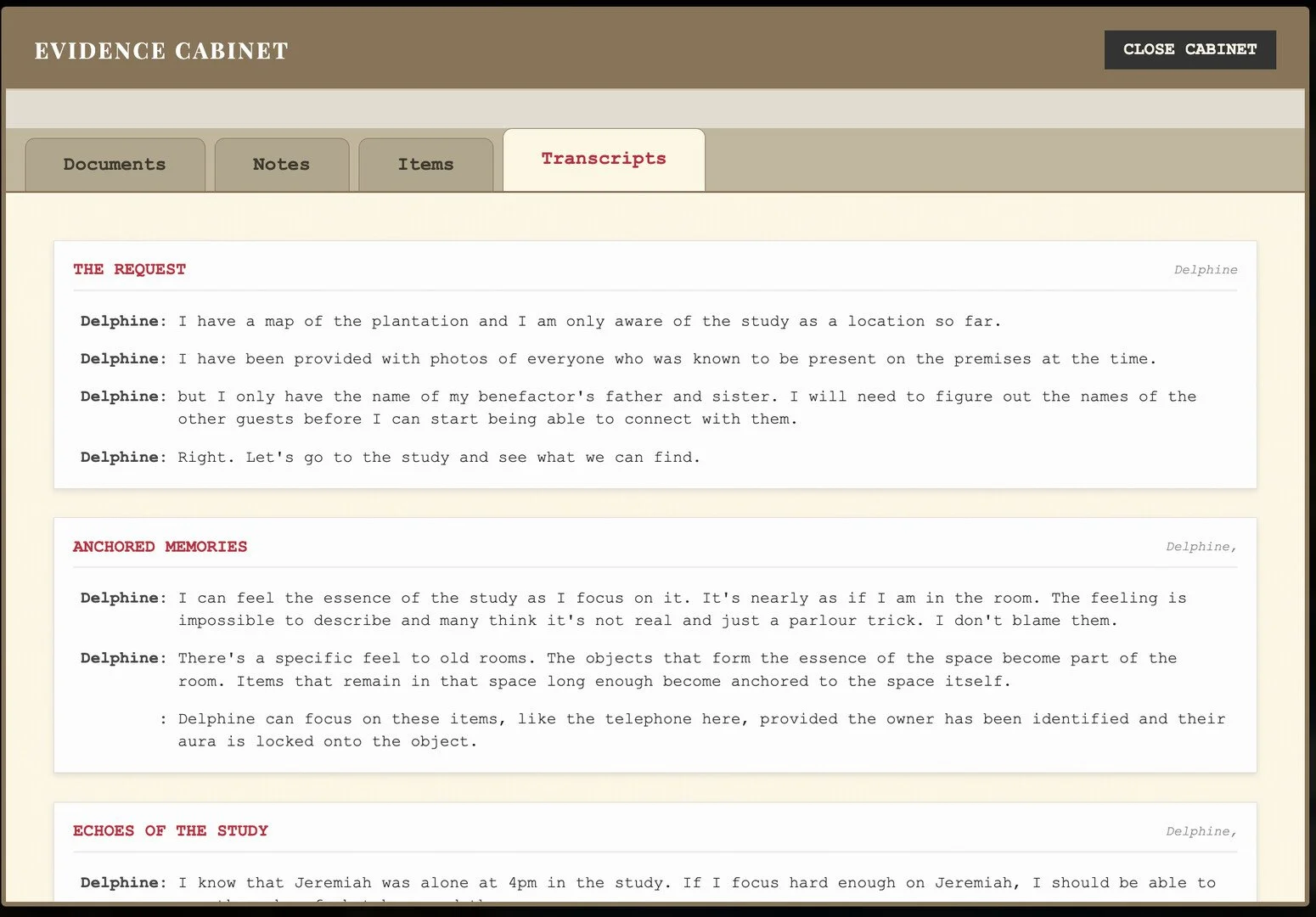
Image: Bushmonkey Games
Look, I suppose ‘favourite’ is pretty subjective. You might argue that just by being in this genre, I was always going to enjoy it but I don’t think that’s really the case. We can look at the two games that have thus far received the ‘Evil Trout’ treatment as an example of that – for the uninitiated, developer Robin Ward, or Evil Trout, has started to garner a reputation for taking free itch.io games and working with the original developers to remaster them as fully-fledged paid-for releases on Steam. He did it for The Roottrees are Dead, one of my favourite games from last year, and is currently in the process of adapting another incredibly well-received game, Type Help, into The Incident at Galley House, for release later this year.
The itch originals of both of those games are, in my opinion, difficult to get into. Treating my contempt for the AI art of the original Roottrees very much as a separate matter, I still find it really unintuitive compared to its remake, to the point that I never found it enjoyable, despite being, as far as I’m aware, almost identical in terms of the puzzles and story. Type Help, too, while likely the biggest individual influence on The Red Pearls of Borneo just doesn’t co-operate with my brain: I get it, I understand the concept, but I’ve tried to enjoy it four or five times now and something just doesn’t click with me.
They are, regrettably, the archetypal ‘free game’ for me: ones which I understand have quality but find too rough around the edges to enjoy personally. And look, while I’m sure you could give The Red Pearls of Borneo that Evil Trout treatment, in a not-dissimilar way to how Type Help is being adapted (with fully illustrated rooms and voice-acted transcripts), I don’t know that it needs it. For me, it’s already entirely accessible as it is – a couple of minor issues, sure, but nothing so severe that I would’ve felt put-out had this been a game I’d paid for.

Image: Bushmonkey Games
Bushmonkey is adamant that The Red Pearls of Borneo will remain free: in fact, as of yesterday morning he announced that it’ll be coming to Steam at that same non-existent price point. And as much as I think it’s worthy of a few shillings, I hope that means that an awful lot more people play it, because it’s deserving of a much wider audience. That’s the whole reason I’m telling you about it, right?
So, if you’re still reading at this point, I trust you will go and try it out – the whole ‘free’ part makes it flat-out the easiest recommendation of my semi-professional career.
The reviewed product is free!
