
Review: The Ratline
Frequent readers will have seen me mention today’s game a couple of times already this year, as The Ratline from Owlskip Games was, I think, my most anticipated release going into this year. I’ve spoken before about how that can be a double-edged sword: obviously it means I was excited to get my hands on it, but there have definitely been games in the past that I hyped up for myself and then, probably due to unrealistically high expectations, felt underwhelmed by.
As for why I was excited for this one in the first place, yes, the sub-genre is certainly my ‘sort of thing’ – I’m bound to get round to anything of note that falls into the ‘narrative deduction’ category – but if you’re as interested in those as I am, you might consider Owlskip as the developer for them. If not in terms of prominence then certainly in terms of being prolific and arguably working in the space before it was even considered a subgenre, having made, I would say, five worthwhile additions to it between 2020 and 2022. Since then, with the rise of The Case of the Golden Idol and the case of The Rise of the Golden Idol (and others, such as The Roottrees are Dead and TR-49) it’s come into a little more eminence: it’s still an area with remarkably slim pickings, but at least some titles that have achieved more wide-spread recognition.
To go back to those previous Owlskip titles, I think it’s fair to say they were a little rough in places – always showing promise, and often doing things that appear to have influenced other, better-known, titles – but also feeling difficult to navigate on occasion, and perhaps lacking that final bit of polish. Four out of five of them also had a musical theme, and I’m not the most musical of people: I almost exclusively listen to the same three bands I listened to as a teenager. Put plainly, I enjoyed those games very much in spite of their theme rather than because of it – but enjoy them, I did.
Ergo, when I first heard about The Ratline, which looked to have addressed both those main issues, in terms of overall polish, and having a theme that I find infinitely more engaging, I couldn’t help but get my hopes up that this might be the game that pushes Owlskip into the discussion – not as a niche developer for people who are desperate to get their deductive fix, but as one whose creates games on a par with the best in the genre.
Image: Owlskip Games
-
Developer: Owlskip Games
Publisher: Owlskip Games
Release: 17 March 2026
Retail Price (Steam): 13,99€/$14.99/£11.99
The Ratline takes place in 1971 and sees players take the role of Saul Perlman, a New York-based private investigator. After solving the relatively inconsequential case of a fraudster hiding out in New Jersey under a false identity – which effectively serves as a tutorial – players find themselves being contacted by an anonymous client who wants Saul’s help tracking down a group of people who are more sinister: Nazis who escaped via the so-called ‘ratlines’, routes that allowed them to flee prosecution by providing them with false documentation and safe passage to various countries around the world.
Specifically, Saul will be looking into those helped by a recently-murdered bishop – Vincenzo Tura – a list of whom was helpfully, if not macabrely, attached to his body by the very knife that was used to kill him. While your employer seems reluctant to reveal the exact purpose of finding these fugitives, you might be able to make some educated guesses about what the plan is for them, particularly given the bishop’s untimely fate. To quote that mysterious voice: ‘Do you want to go after them, Mr Perlman? These Nazis? These killers? Many of them live comfortably, growing old and fat. They believe they are beyond our reach.’
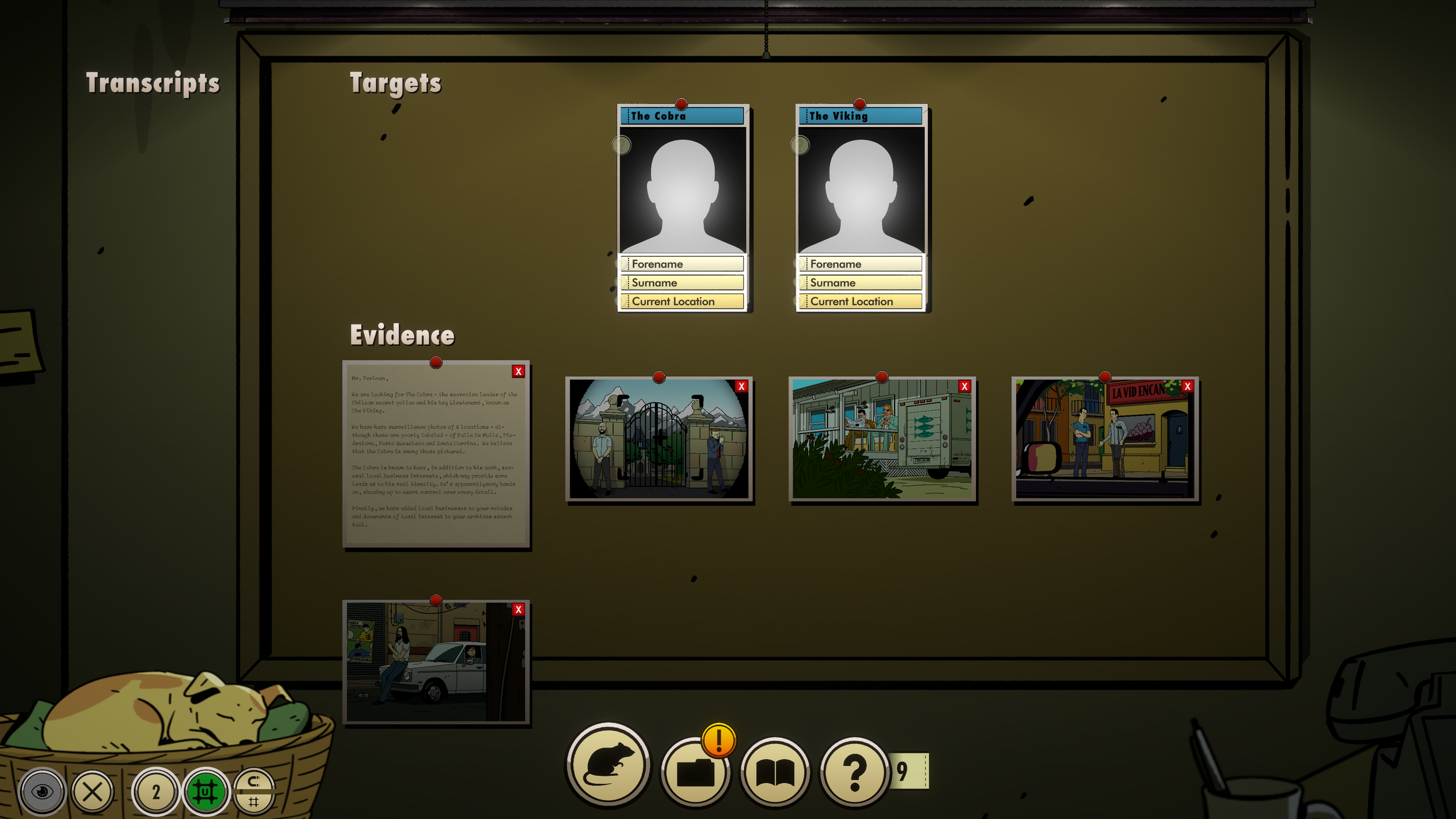
Image: Owlskip Games
Thus begins your investigation into the names on the list. Your first case is that of the Schulz brothers, Ralph and Fritz, with a loose thread to Buenos Aires being more-or-less all you have to go on. As with your New Jersey-based fraudster, you need to identify each of them in a photograph, establish the alias they’re living under, and provide their current location.
That is not the most straight-forward of tasks. You’ll start each case with a handful of documents – in this case an unlabelled photograph of a group of soldiers and a letter seemingly from the Schulz’s mother – and will need to dig up further information from there. Your primary tools to do so are through making telephone calls, and by accessing the archives of the New York public library. For phone calls you’ll need to cross-reference names that appear in documents, typically for businesses, with those in your rolodex – if you think there’s someone who might have information that can help, you can give them a bell and ask a few questions. That can be a little fiddly at first (navigating between the documents and the phone and the rolodex) but you quickly get into a rhythm and once you’ve done it a few times it becomes second-nature.
The archives are even easier to handle: simply type in the word you want to search, and if there’s a document pertaining to that it’ll pop up. There is some subtlety to that: you wouldn’t be able to just search ‘Schulz’ in and get a load of information about them, but as long as you’re paying attention, what those search terms should be is usually pretty well-telegraphed. By default there’s a helpful tracker on-screen which tells you how many vital pieces of evidence you’ve still got left to find: that can be disabled in the settings but unless you’re a real puzzle-masochist I wouldn’t recommend it, as the game is difficult enough without depriving yourself of that knowledge.
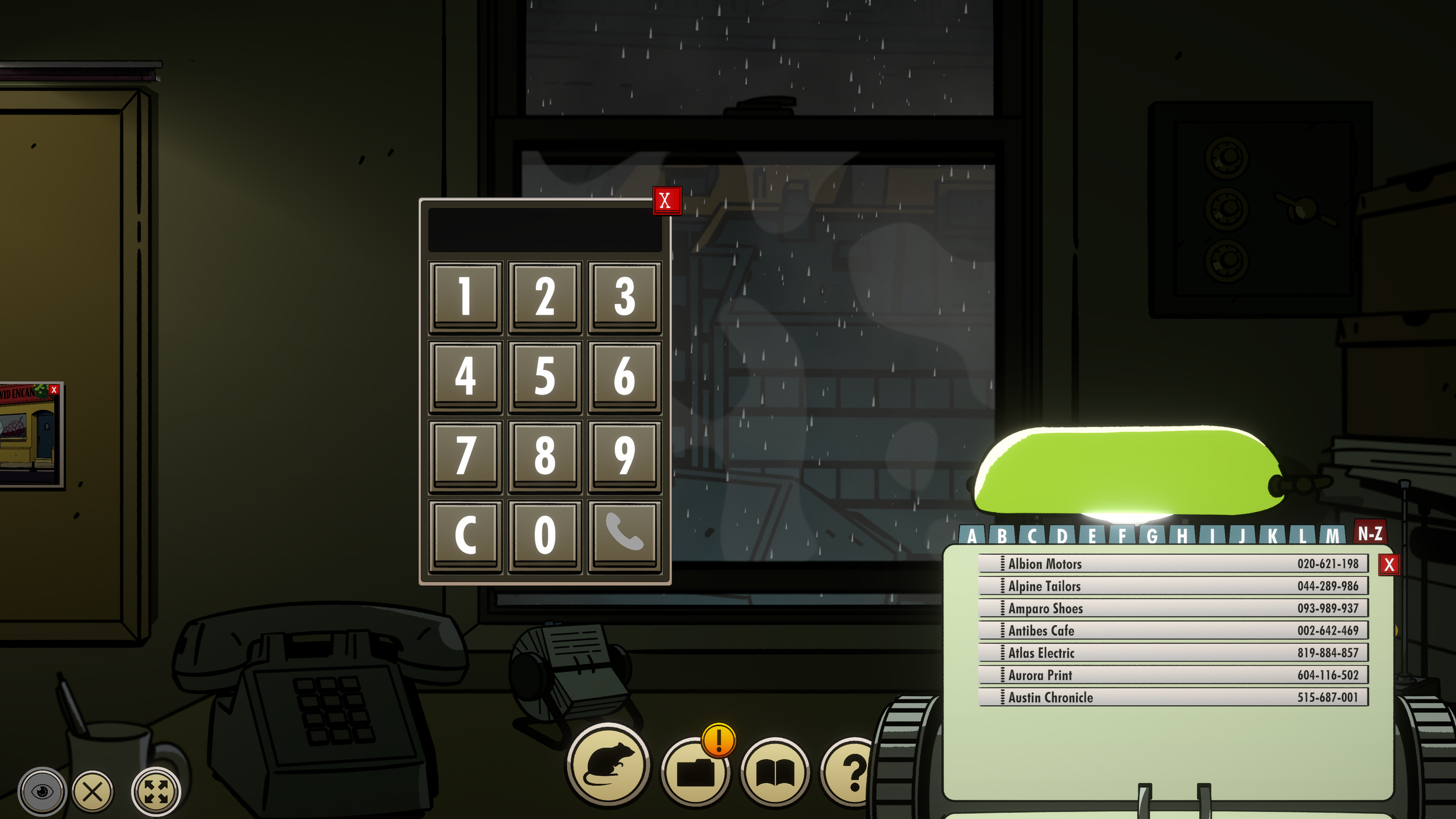
Image: Owlskip Games
Acquiring the documents is only half the battle, and it's usually much easier than the second part: actually putting the evidence you’ve collected together in a way that solves the case. I think a lot of that process can be divided into two categories, albeit with a lot of cross-over: there are the sections that I would say feel more realistic, where you’re combing through documents, transcripts or images to try and identify your targets – probably what you would more commonly associate with a deduction game – but then there’s also the purer, more obvious ‘this is a puzzle’ side of things, where you do have to suspend your disbelief a little more.
Often those puzzles are framed as clandestine codes being used to keep information secret – and that’s pretty easy to go along with – but even when they are pushing the plausibility out a little further, the game very much benefits from their presence. They’re all very well-designed – there’s some tricks that fans of the genre – or Agatha Christie novels – might recognise, but plenty of others that are novel to this game. It’s worth mentioning that the cases here aren’t quick: I’d like to think I’m relatively good at these sorts of things yet most of them clocked in at around an hour, some longer, and the variety provided definitely helped break up the gameplay far better than if every problem was the same trick repeated over and over again with minor tweaks, as can sometimes be the case in these sort of games.
To touch again on the difficulty, I’ve hinted that this is not an easy game, and I would say that The Ratline tends harder than most of its contemporaries: for me that was one of its main positives. I never encountered something that I felt was unfair – no ‘how on earth did you expect me to figure that part out’ moments – but certainly parts that I struggled with, and others which, when I found the solution, made me frustrated at myself rather than at the game.
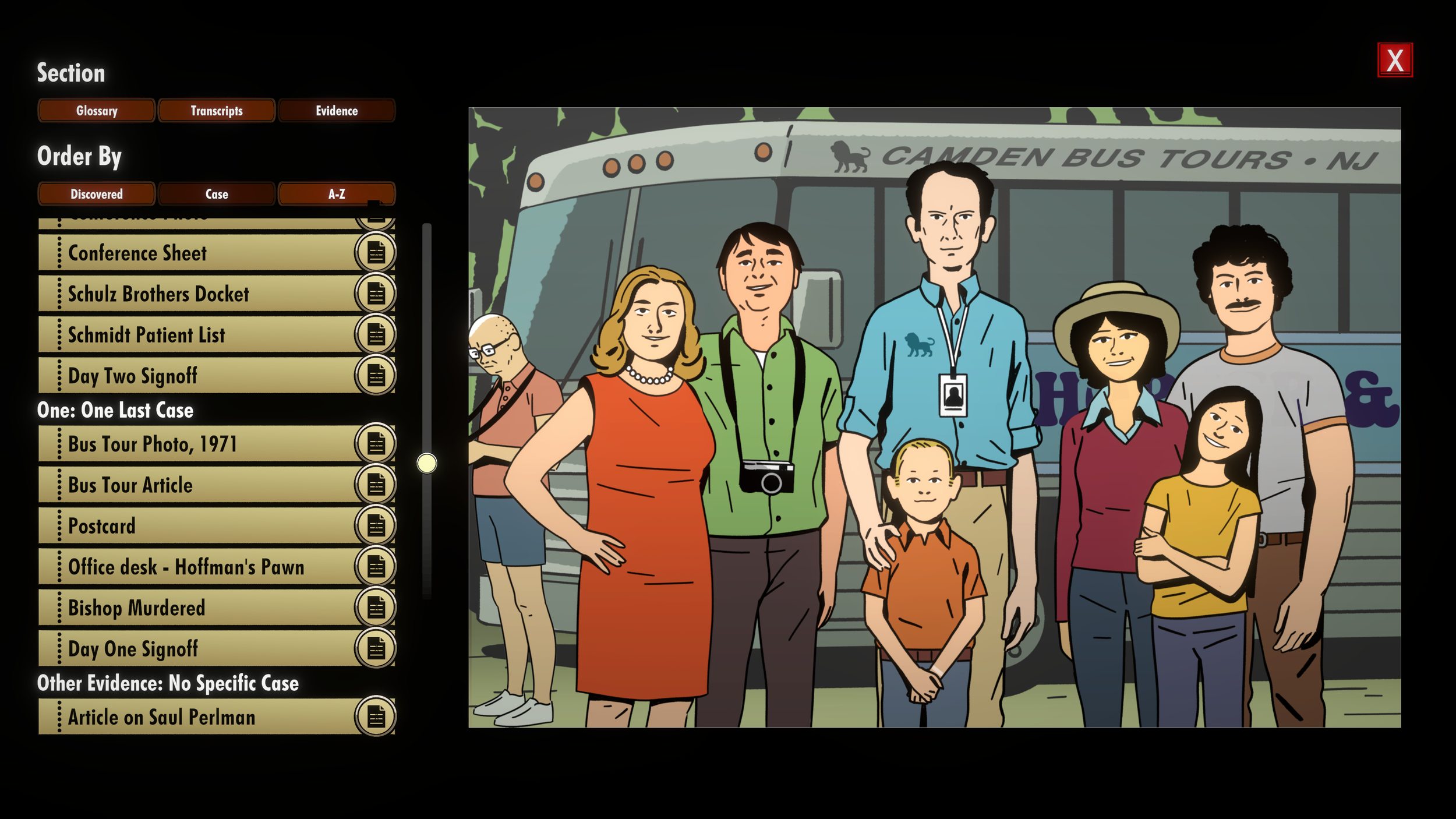
Image: Owlskip Games
If I’d wanted to avoid some of that frustration, there is a very generous clue system which will give you a small hint, then a bigger one, then, if you really need it, tell you the answer to what you’re stuck on. There are hints for everything in the game – if you’ve got documents left to find and don’t know where to look, they’ll point you in the right direction, if you’ve got all your documents but are struggling to figure out what photo, name, or location to attach to a target, you can get hints for that. It’s probably the most obvious solution to managing difficulty in this sort of game, but sometimes the obvious solution is the best one – overrelying on it could somewhat ruin your fun, but there were a couple of occasions I used it to find a pesky document which was alluding me and was happier for it.
There were a couple of things I didn’t always love but which both felt like necessary evils: there’s a gap-fill that pops up at the end of each level where you input some words to complete your case report – an exercise turns the difficult knob from ‘challenging’ to ‘very-much-not-challenging’ – but which gives players the full story if there’s parts they’ve missed and, rather than just sticking it up as a sheet of paper for them to read, provides some level of interactivity. There’s also the occasional dialogue that can be little dry, not the majority by any means, and from a practical standpoint I think it can be difficult when there’s information that needs to be conveyed for the player to progress: if you take it too far in the other direction you either obscure that information too much, or end up with characters who are supposed some guy working in a florist speaking like they’re the Riddler.
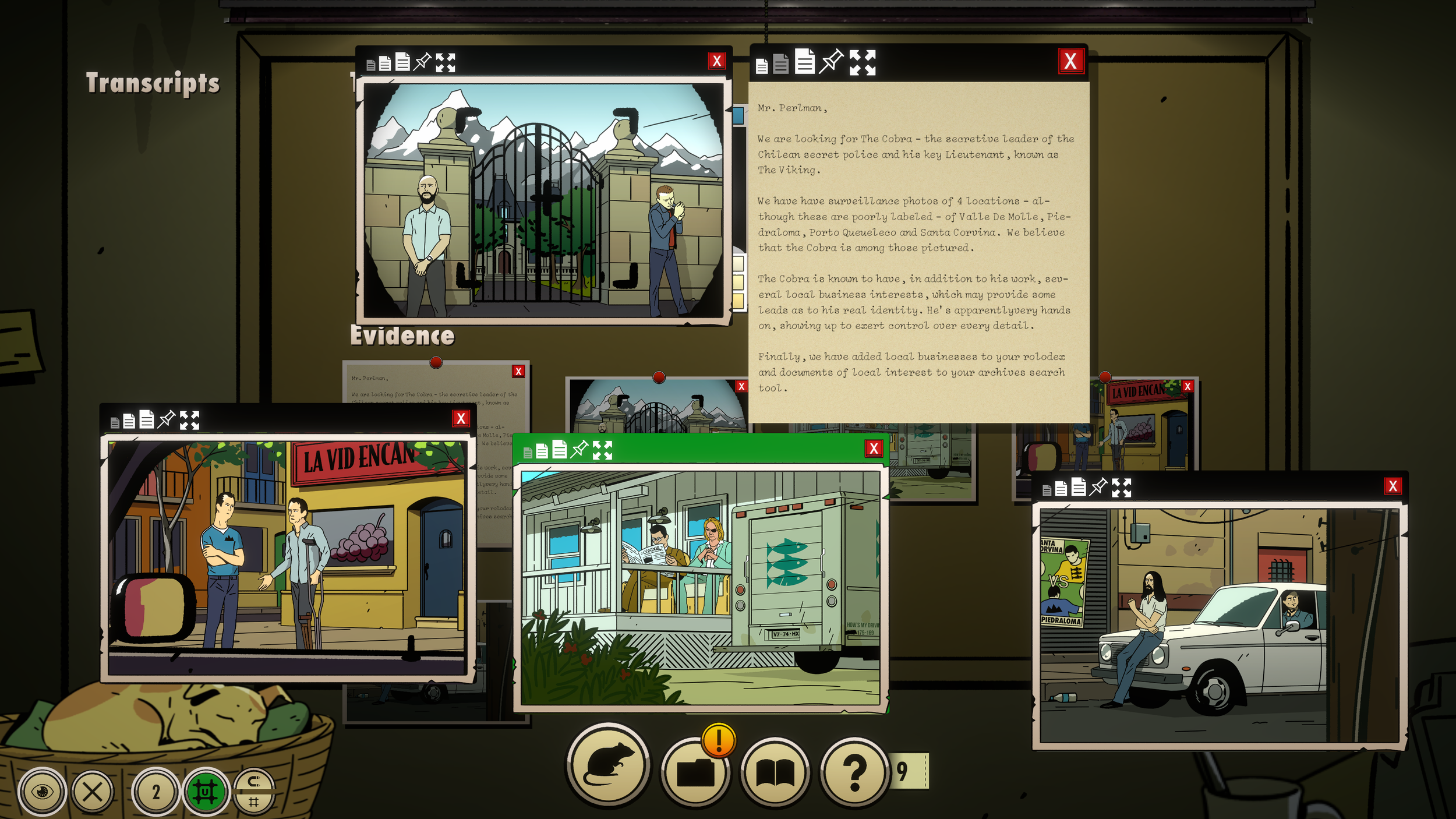
Image: Owlskip Games
To quickly touch on the narrative side of things, from initial impressions I was a little worried that the cases would play out in a way that was, overarchingly, unsatisfying: like an anthology of sorts, with nine separate stories which might be interesting individually but not amount to anything greater than the sum of their parts. While I don’t think having a story that ties everything in together is necessarily… necessary, I do think things would’ve felt a bit tepid had it just been ‘here’s the list, let’s tick off the bad guys one by one, and once that’s done we’ll roll credits.’
Thankfully, there are some clever connections between the cases that serve to give it more structure: it’s difficult to go into that too much without giving things away, but it’s clear that some of the people you’re investigating are known to one another. That never becomes tedious: each case works as its own individual vignette without bleeding too far into the others and making them feel less unique, but with minor threads here and there linking them together into a more coherent piece overall.
Ultimately The Ratline provided everything I hoped it would: an incredibly worthy addition to a fledgling genre which holds its own against the best of them. If you’re a fan of deduction games it’s a must-play, and unless you can’t stand them (in which case, why are you still reading this article?) I’d still strongly recommend it.
The Ratline is awarded a 9/10 by IndieLoupe.com.
The reviewed product was provided on behalf of the developer.
