
In Legion Was Here you play as the eponymous Legion, a spy with the unique (and incredibly useful) ability to change your appearance to flawlessly match any given target. Naturally, that skill puts you in high demand with some of the world's most powerful espionage agencies, who, among other things, recruit you to infiltrate terrorist cells, mafia families and… wedding parties.
-
Developer: Geoffroy Monde
Publisher: Surefire.Games
Release: 13 October 2026
Retail Price (Steam): 10,25€/$9.99/£9.09
You'll be given a target by your employer, who'll always provide you with a conveniently (for the game's premise, less-so for you as a spy) patchy file – God forbid anyone ever has a straight-forward mugshot of a high-profile criminal. Instead, they'll be full of partial photos or loose written descriptions, which you'll need to scour through in order to find clues that help you build a profile of the person you're impersonating. Once appropriately prepared, you'll assume their identity and meet with their associates in order to prevent whatever heinous crime they might have planned.
The plot is as ridiculous as the premise makes it sound: where many narrative deduction games have a fantastical element to them (such as Legion Was Here's face-changing ability) they're then otherwise grounded in some level of reality. Legion Was Here only gets more chaotic as the game goes on, and there isn't much that's off the table in terms of the story. An example of one such plot involves Neptunian aliens going undercover as clowns planning to blow up Mount Rushmore, which may be both figuratively and literally the most 'out-there' of the game's missions, but not by a huge margin – it's pretty much par for the course in Legion's world. When I say you don't know what to expect with each new case, I really do mean it with this one.
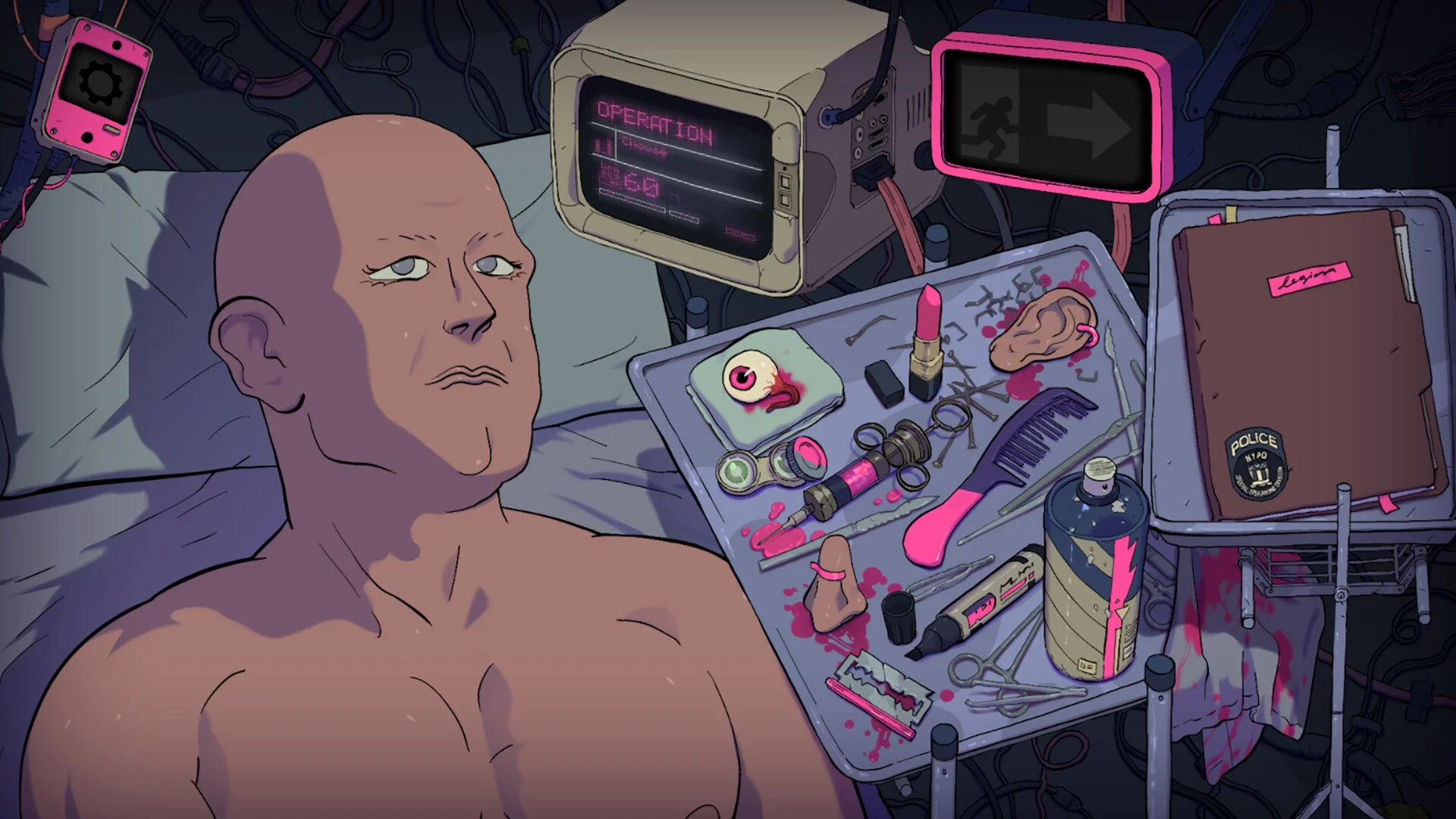
Image: Geoffroy Monde / Surefire.Games
As mentioned, every level has two phases: one in your secret laboratory where you're combing through the brief to familiarise yourself with the target and shape yourself in their exact image, and then one where you head out on the actual mission. For that first part, there are two key areas that players simultaneously need to think about: it's all well and good looking identical to the person you're impersonating, but as you're going to have to have a full conversation without letting it slip that you're an imposter, you also need to learn a thing or two about them. If, for example, you're posing as an international terrorist and meeting a known associate, you'll probably want to do a bit of research on the relationship that the two share, lest your deception be quickly uncovered.
To help you recall any important facts you've learnt, you have a second, somewhat less remarkable, ability: to jot down the most pertinent information on your hand, as any real spy would surely do. Historically whenever I've played an information-heavy game where I need to recall that information further down the line, I finish my playthrough with several sheets of scribbled notes to the side of my keyboard – even when there's an in-game notepad it usually remains empty regardless of how well-designed it is, as I just find it easier (and perhaps more fulfilling) to have those physical notes sat there on my desk.
I think Legion Was Here marks the first time I've actually put a notes feature to good use, not only on account of the novelty of it all but because, vitally, your hand-notes come with some pre-existing categories: you're not completely shooting in the dark, but have a good 10-20 points of interest that you're guided towards. I would say that's necessary and that the game would feel unfair without it: given how different the scenarios are to one another, and how outlandish some of them get, it would be impossible for players to know what information they might need without that extra bit of guidance. That's not to say that it covers absolutely everything, and you'll still need to dig into those files thoroughly to discover all the details that you're searching for.
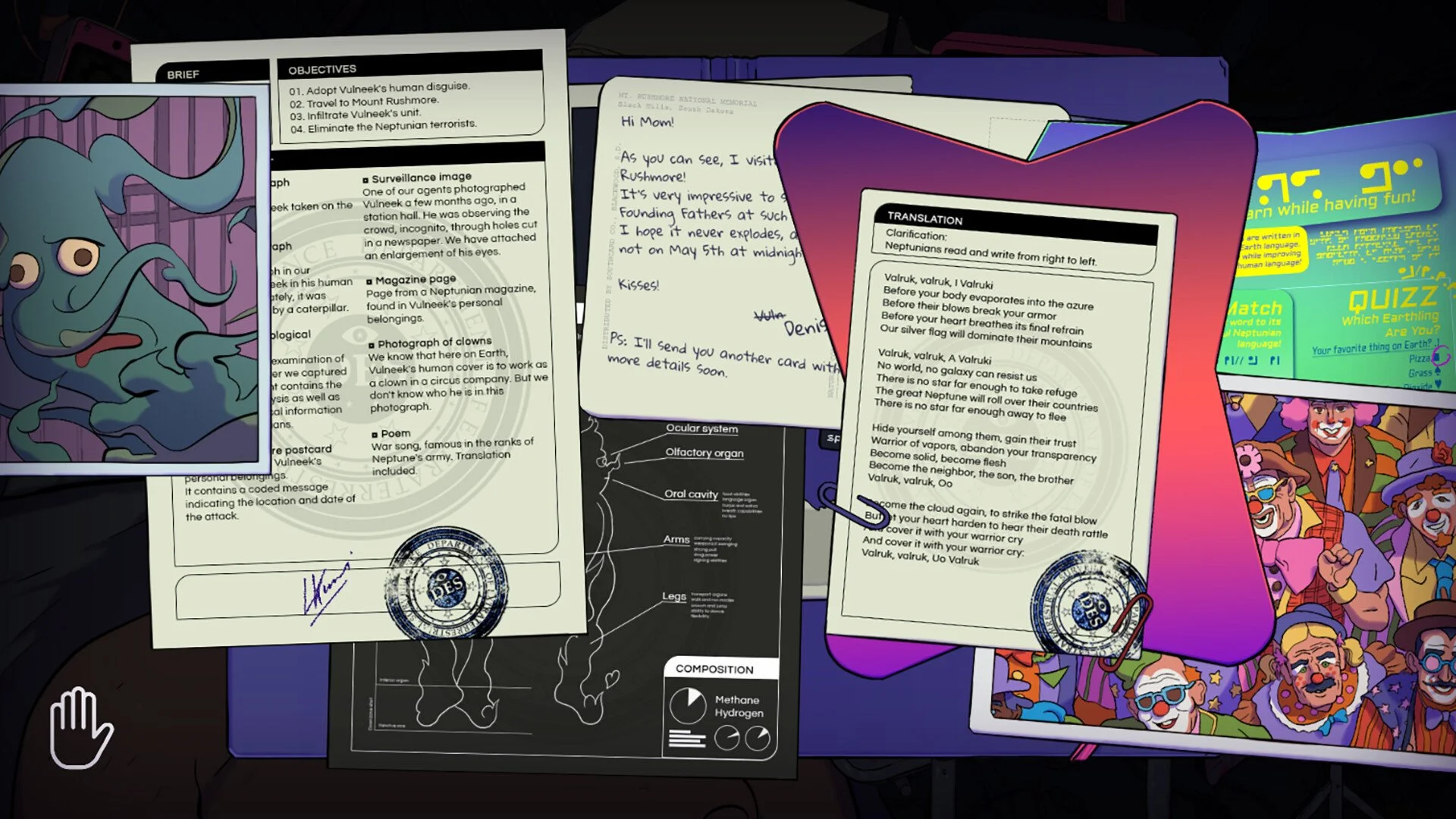
Image: Geoffroy Monde / Surefire.Games
Legion Was Here includes six self-contained missions, for around three to six hours of gameplay depending on how leisurely you want to take things, how deep into the weeds you want to get, and whether you're trying to achieve 100% in every level. For me that was the perfect length: I think it takes the concept about as far as it can go, without any of the missions feeling repetitive or as if they're reiterating on things the game has previously done.
In fact, the final level offers a few big twists on the formula established during the rest of the game – not in a way so dramatic that it feels unfamiliar, but it certainly stands out as something very different to the previous five levels. Even within the game's completely bizarre world you do need to suspend your disbelief a little, as it contains clues that were buried in documents from previous missions in a way that, to put it bluntly, makes absolutely no sense — but the puzzles it facilitates and the payoff it provides for the game's story just about make it worth it.
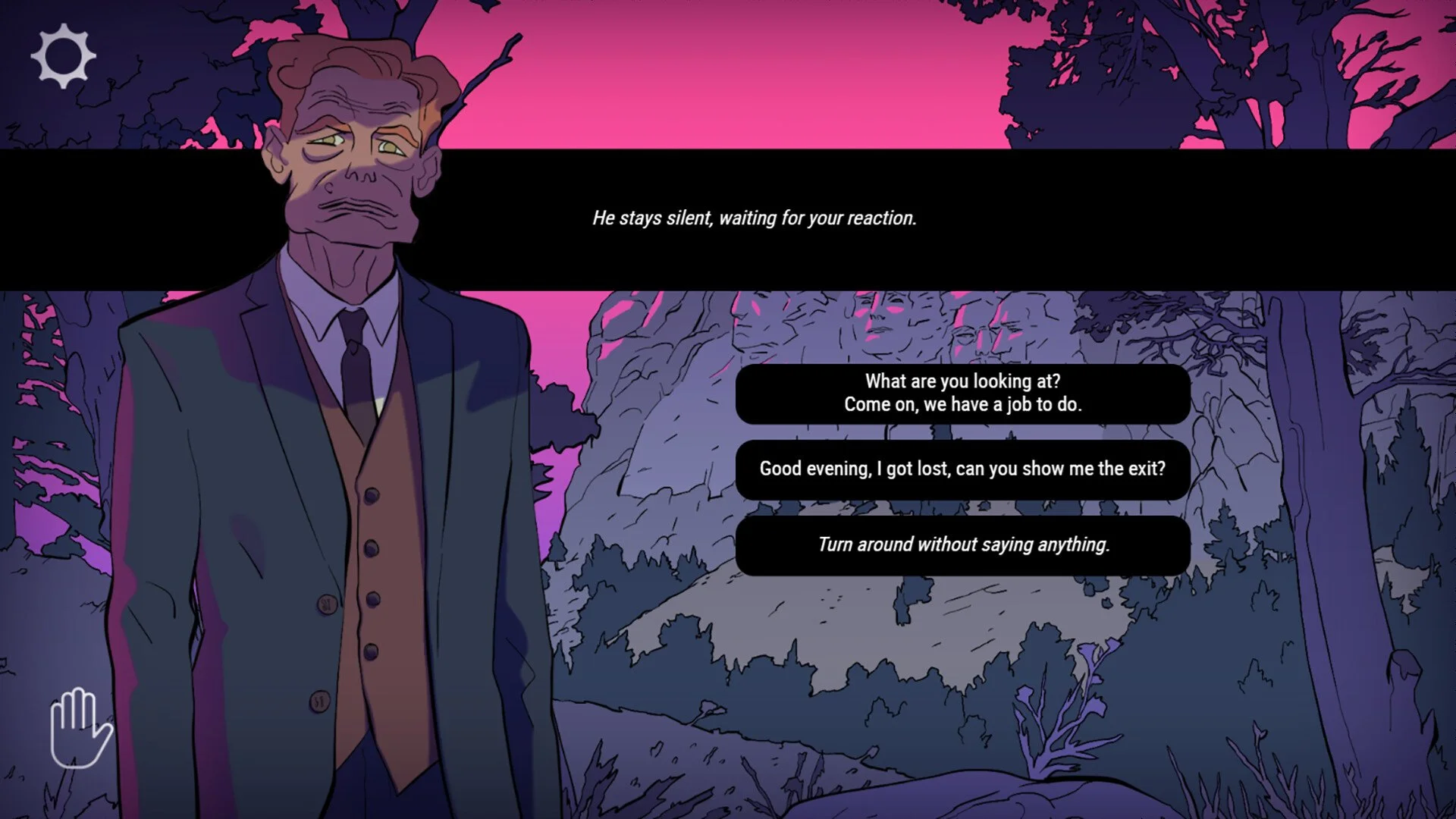
Image: Geoffroy Monde / Surefire.Games
Some things can be reverse-engineered in a way that's not possible in similar deduction-based titles: because you know you're looking for specific facial features and only have a handful of options to choose from, you're getting quite a bit of information just from that. It's something of a necessary evil with the game's concept, but there was at least one occasion where I suspected someone was my target because they had facial features that were available to me, rather than because of any logical deduction. I still had to go and find the evidence to back that suspicion up, but, when I did, I didn't get that gratification which you usually get from solving a puzzle – it felt like I'd cheated to get the answer, that I hadn't done it 'properly'. There are plenty of red herrings to send you down the wrong path, but there's only so many ways the game can obfuscate information without also making its solutions too difficult to find.
In a similar way, I think it's a little easier to ruin your own fun in this one than in some of its contemporaries: while you'd still need to look the part and get the physical features (mostly) correct, if you're so inclined you can quite easily go into the mission and brute force yourself towards some of the facts about target, finding what's right and wrong by repeatedly going through the dialogues rather than looking into the documents as the game intends. That is somewhat counteracted by the fact that you aren't always going to be asked the exact same questions every time, but they do typically share a theme: you might not know the exact question you'll get, but, much like going into a test having been tipped off that a specific subject is going to come up, it helps narrow down what you need to know. I don't think it's a huge problem, but the old adage that 'given the opportunity, players will optimize the fun out of a game' rings true, and I found I was slightly disincentivised to really dig into the files, knowing that I could effectively retake the test afterwards if there were any gaps in my knowledge.
There were also a handful of moments where I found the solutions a little too dense (I think – it could be me that's a little too dense) and I struggled to get the correct answer, even if I knew the question that was coming up. On each occasion I could go back afterwards and at least understand the logic I was expected to follow, but only on account of already having the answer: I don't think I'd have ever come to those conclusions on my own. I think a couple of those were translation issues, where a word or phrase was used slightly awkwardly and added an accidental layer of complication, but otherwise the English version is incredibly solid.
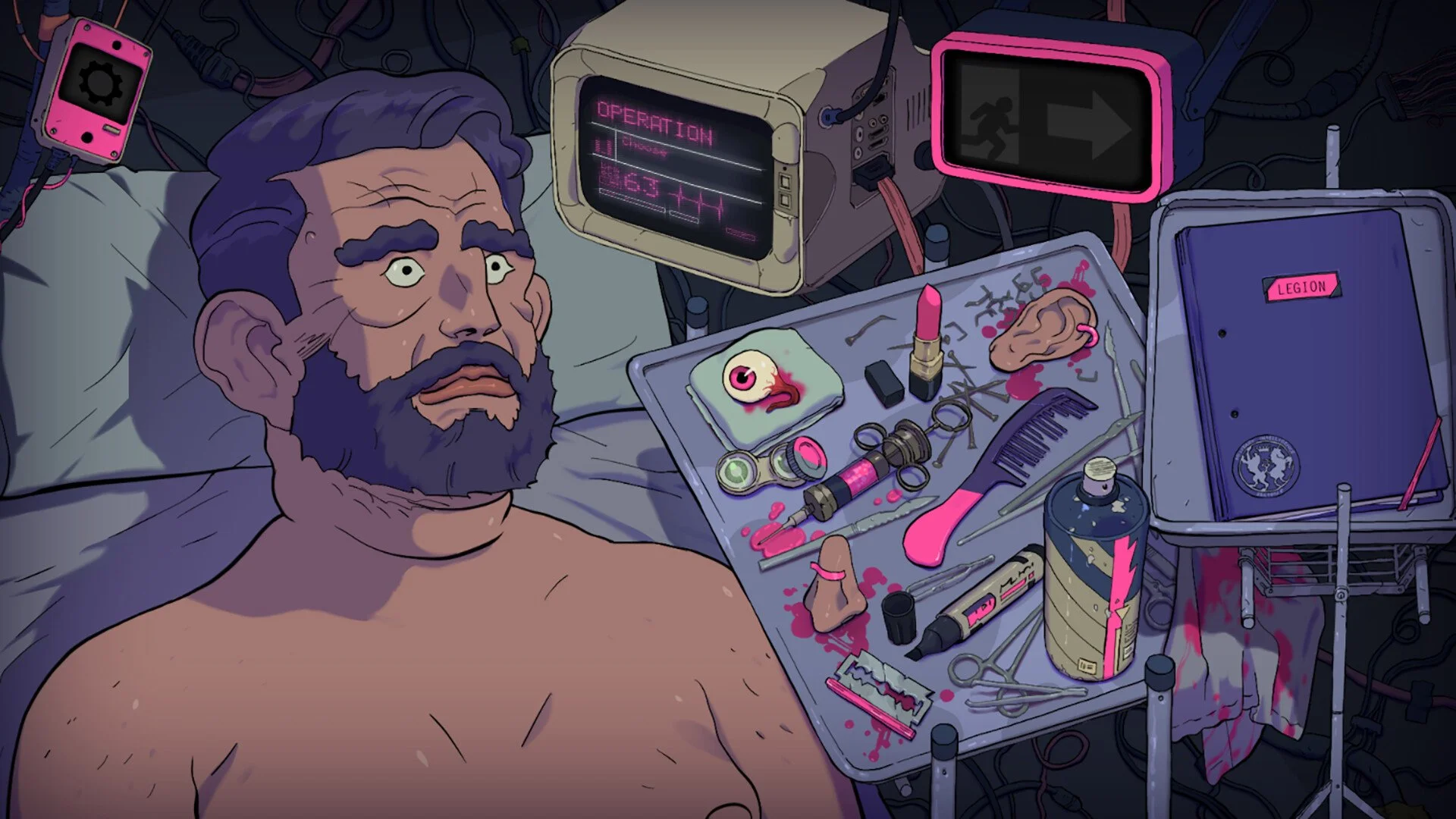
Image: Geoffroy Monde / Surefire.Games
Legion Was Here is a wonderfully unique game which takes its elevator pitch of a premise and executes that to its fullest extent. While it obviously doesn't take itself too seriously, the puzzles are still, for the most part, well designed and its quirkiness doesn't stand in the way of offering challenging and absorbing gameplay.
Legion Was Here is awarded an 8/10 by IndieLoupe.com.
The reviewed product was provided by the publisher.
